
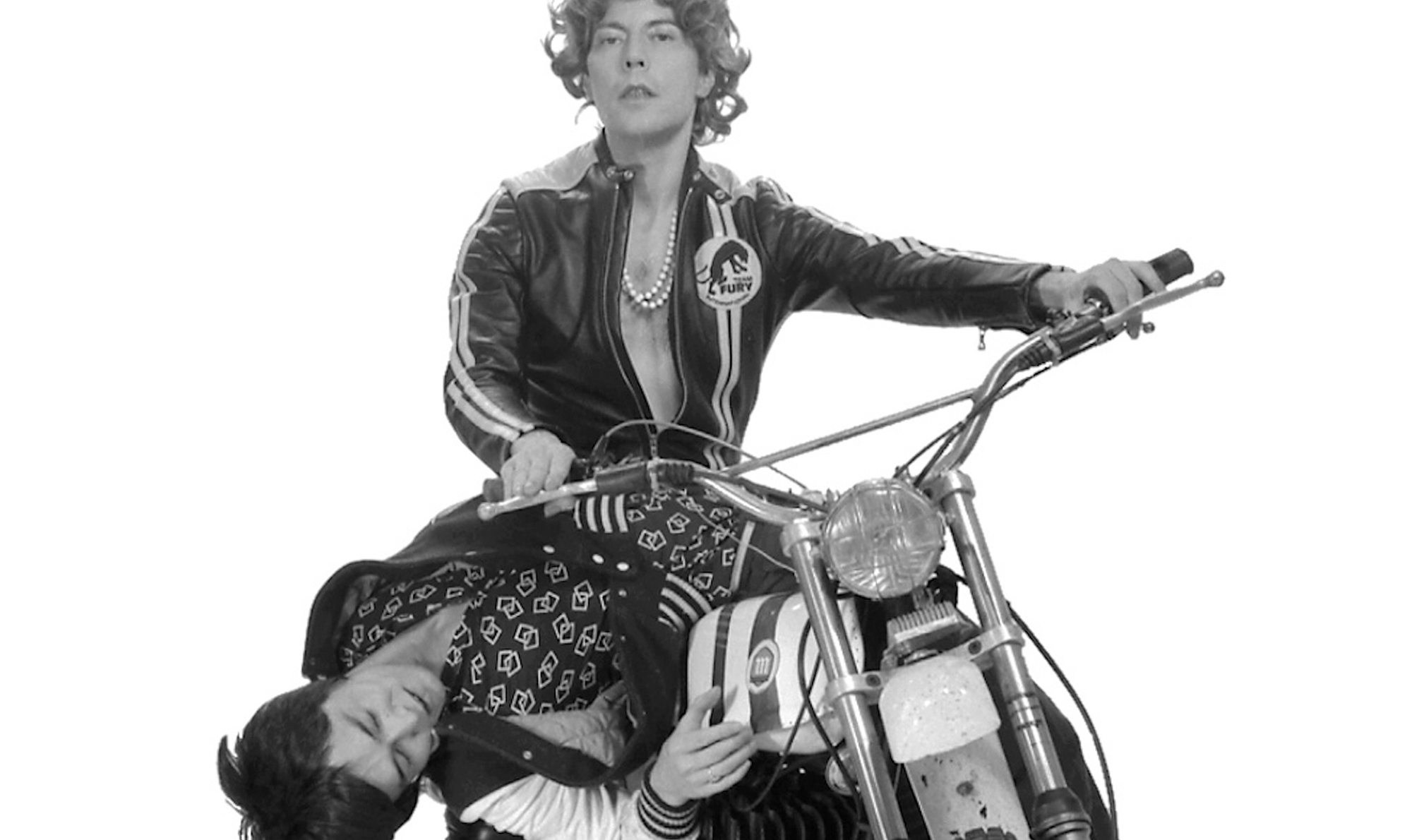
A tale of two artists1: Michel Journiac and Robert Morris, working in parallel yet separated by an ocean: — “so near and yet so far” —, both testing the expanded contexts of conceptual art itself in terms of proximity and difference. Two artists divided by the Atlantic — once united by the air and the energy of Paris. Both were epigones, sons of Marcel Duchamp; both artists reacted against a conceptual art milieu that prioritised depersonalised text and images. Journiac and Morris engaged with performance, photography, sculpture — and both artists played with nazi imagery; both turned from a conversation with conceptual art to a gold or silver-plated “gay baroque”. What one learns from this comparison goes beyond mere parallels or theories of the Zeitgeist: Morris (born 1931) and Journiac (born 1935), were unusual in their contemporaneity: both created memento mori for their times. To look at Journiac’s work beyond a monographical focus changes the discourse on the artist and makes a claim for his more international recognition. I discovered both artists in 1994, the first in the New York exhibition Robert Morris: The Mind-Body Problem2, and Journiac at the Centre Pompidou’s Hors limites: l’art et la vie, 1952-19543.
What is man, a naked man, doing inside a piece
of conceptual art?
Despite intense exchanges between the 1960s and 1980s, the differences between France and America in terms of language and cultures, but also philosophy and mindset are far-reaching: hence the questions raised by this comparison. The attempt at a dialogue between Anglo-American and French philosophers at Royaumont in 1958 was a disastrous failure4. 1966 saw both the publication of C.A. Van Peursen’s Body, Soul and Spirit: a survey of the mind-body problem (not known, I think, to Morris) and Wittgenstein’s Lectures and conversations on Aesthetics. Wittgenstein had a huge impact on conceptual art on its transatlantic axis, including the Art & Language group (based near Oxford; later New York) who held an aversion to what they later called in print “the French disease” — referring to the intellectual impact of the translations of the texts of Barthes, Foucault and others, eagerly promoted in New York via Sylvère Lotringer’s Semiotext(e) series from 1973 and the work of October magazine, founded in 1976.
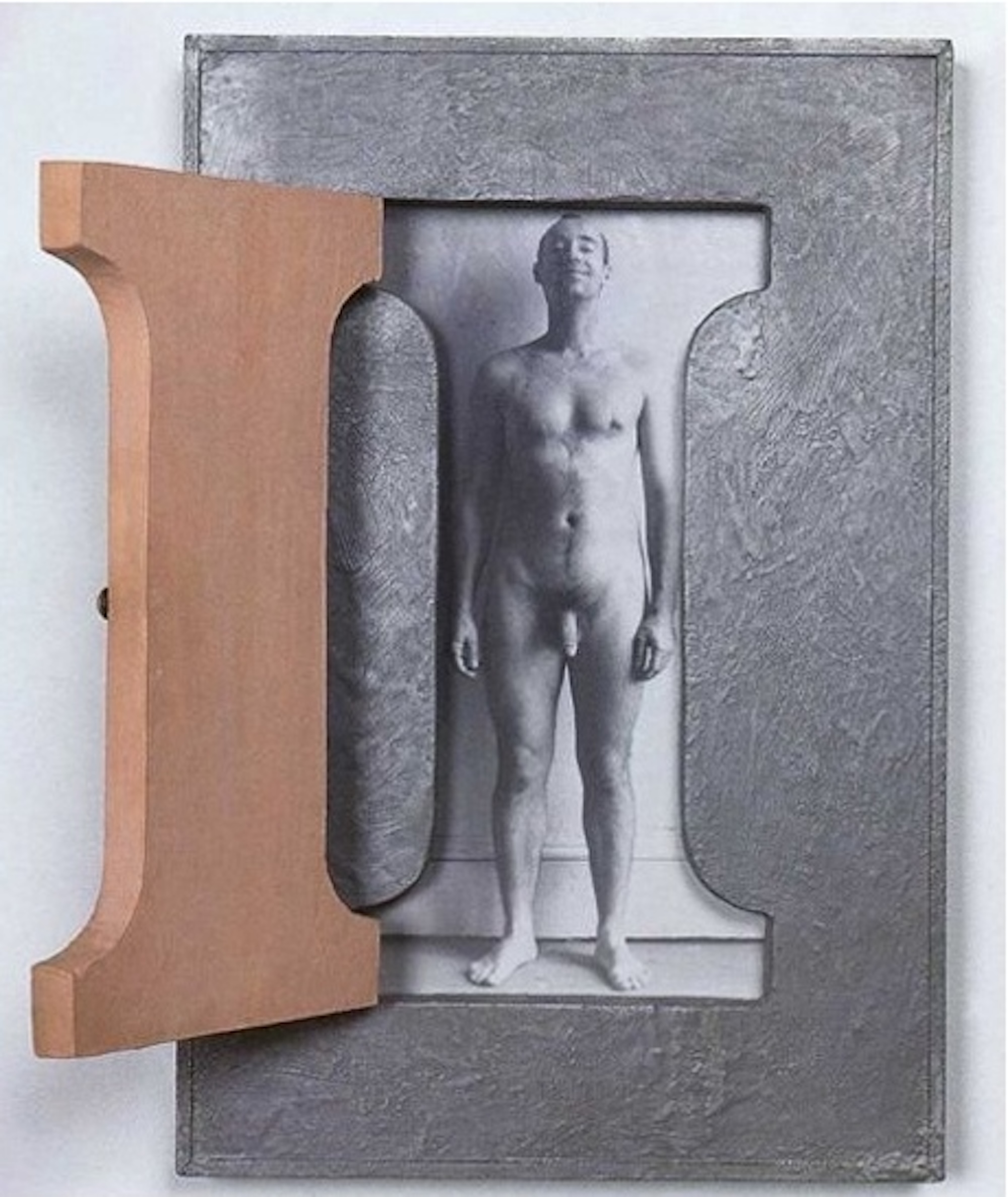
Both Journiac and Morris, not professional philosophers, broached similar questions with different intellectual lineages. The two œuvres examined here are recalcitrant, indeed disobedient in terms of a “pure” conceptual model. Robert Morris’s I-Box (1962) [fig. 1], shows a photograph of the naked artist, miniaturised within a lead “I”–shaped frame, with a hinged wooden door: it would peer through the cut-out cover of his 1994 retrospective catalogue.
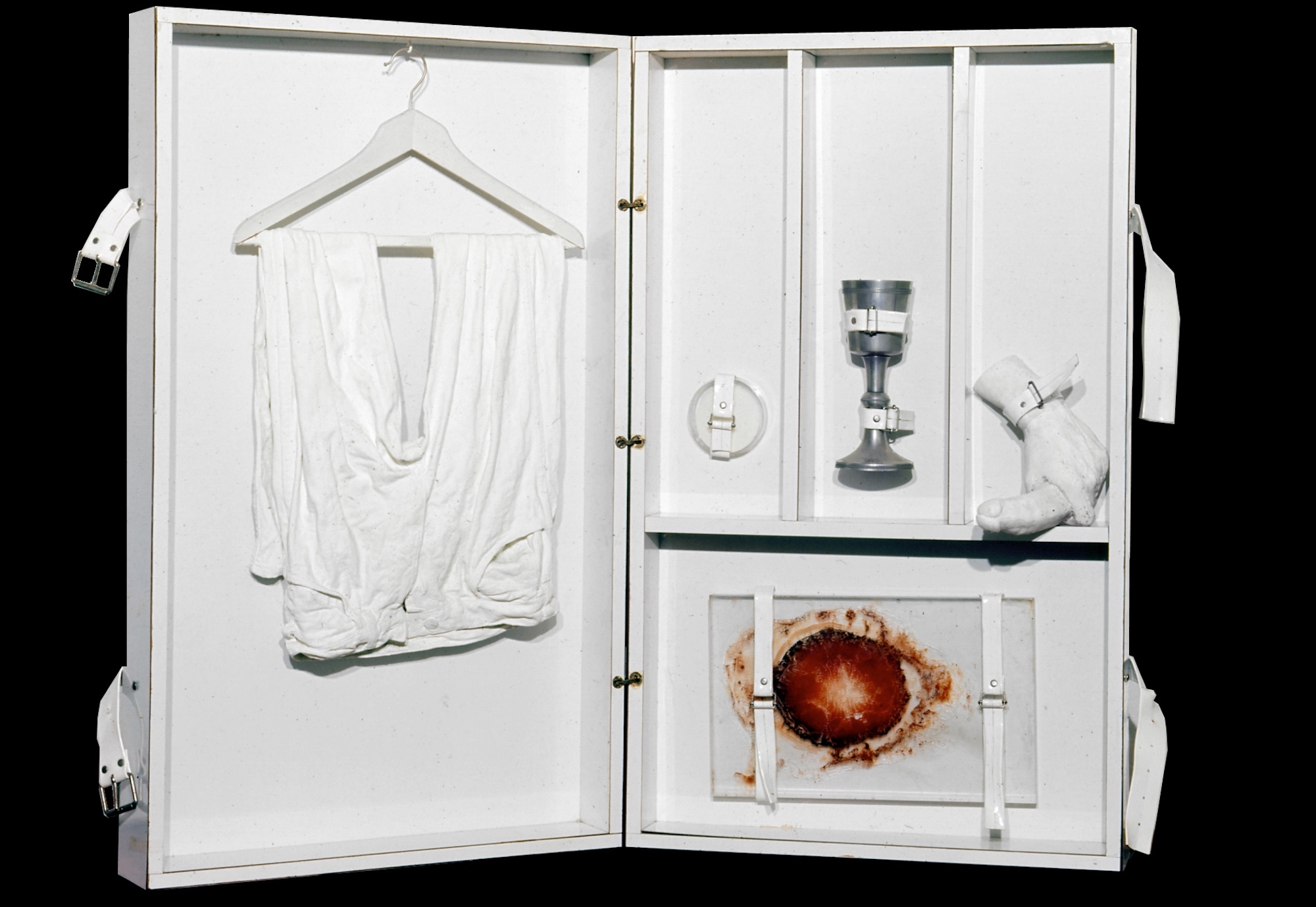
What is man, a naked man, doing inside a piece of conceptual art? One may compare it as a self-portrait to Michel Journiac’s Autel portatif (1969) [fig. 2], which can also close as a box. There is no body here (it is present in absentia) but white long johns, a strapped-in chalice, a circular box of communion hosts, a bloody wound, and, in plaster, a hand masturbating a penis. Both Morris and Journiac in their separate ways challenge conceptual art with a notion of contamination; they challenge the exclusivity of its practice via sculpture, performances, the intrusion of body, matter, and the Baroque (here kitsch). Journiac — a self-unfrocked Catholic priest-in-becoming — deploys a post-Duchampianism which reverts to older theological debates: those around incarnation, transubstantiation and the symbol — the mind-body problem encounters the sacred.
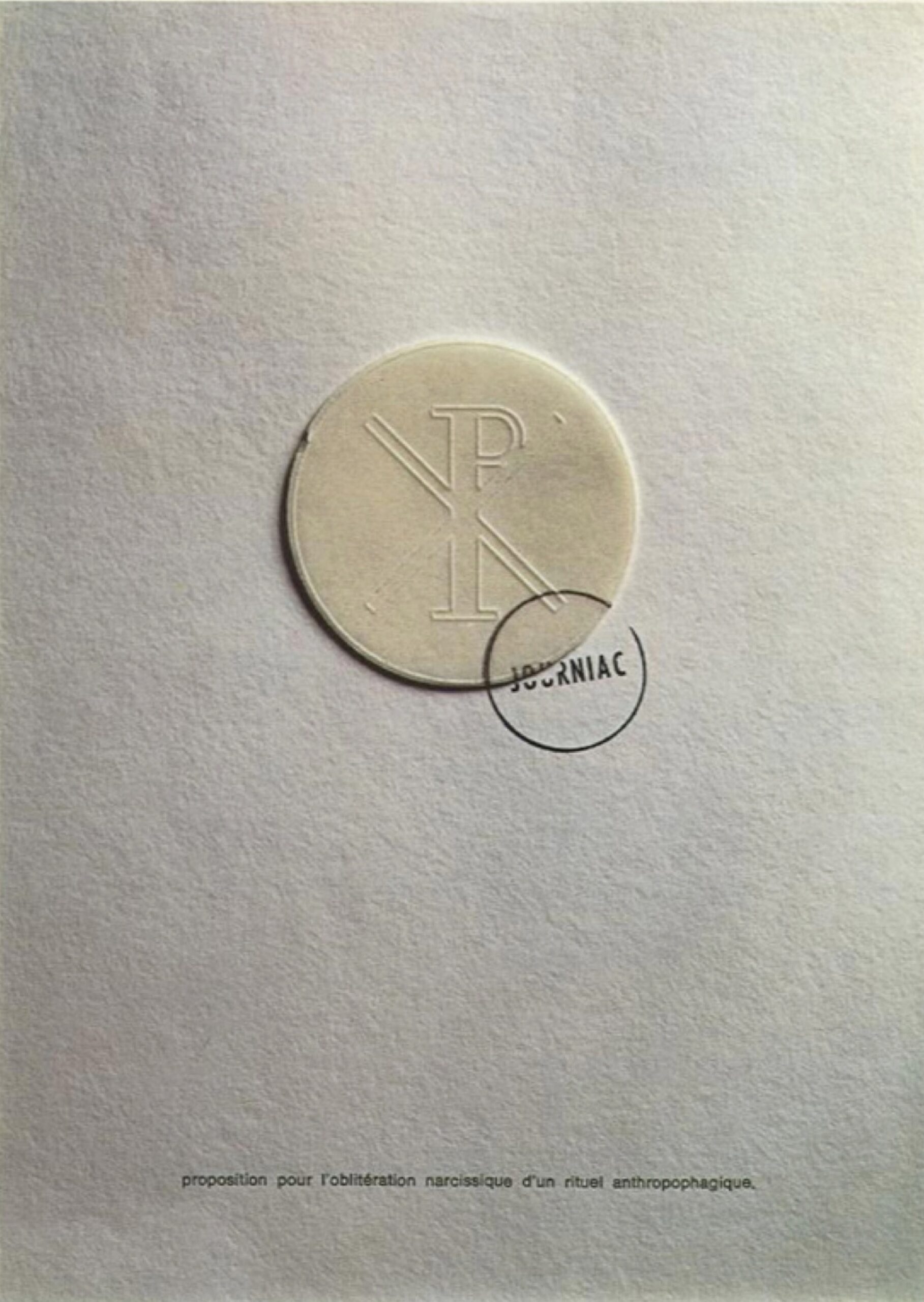
The sacred — the Catholic Mass — requires belief in the material signs of spiritual transformation. As we know, Journiac conducted a mass in the Galerie Daniel Templon, first in 1969, then for the camera at the Galerie Stadler (1975), with a sacred host made from his own blood turned into a boudin, grilled and sliced. The words, Hic est corpus meum5, acquired a material truth-value: blasphemous or self-sacrificial? Journiac also framed communion hosts in quasi-conceptual works such as the wafer he stamped with his name for Proposition pour l’obliteration narcissique d’un rituel anthropophagique (1973) [fig. 3].
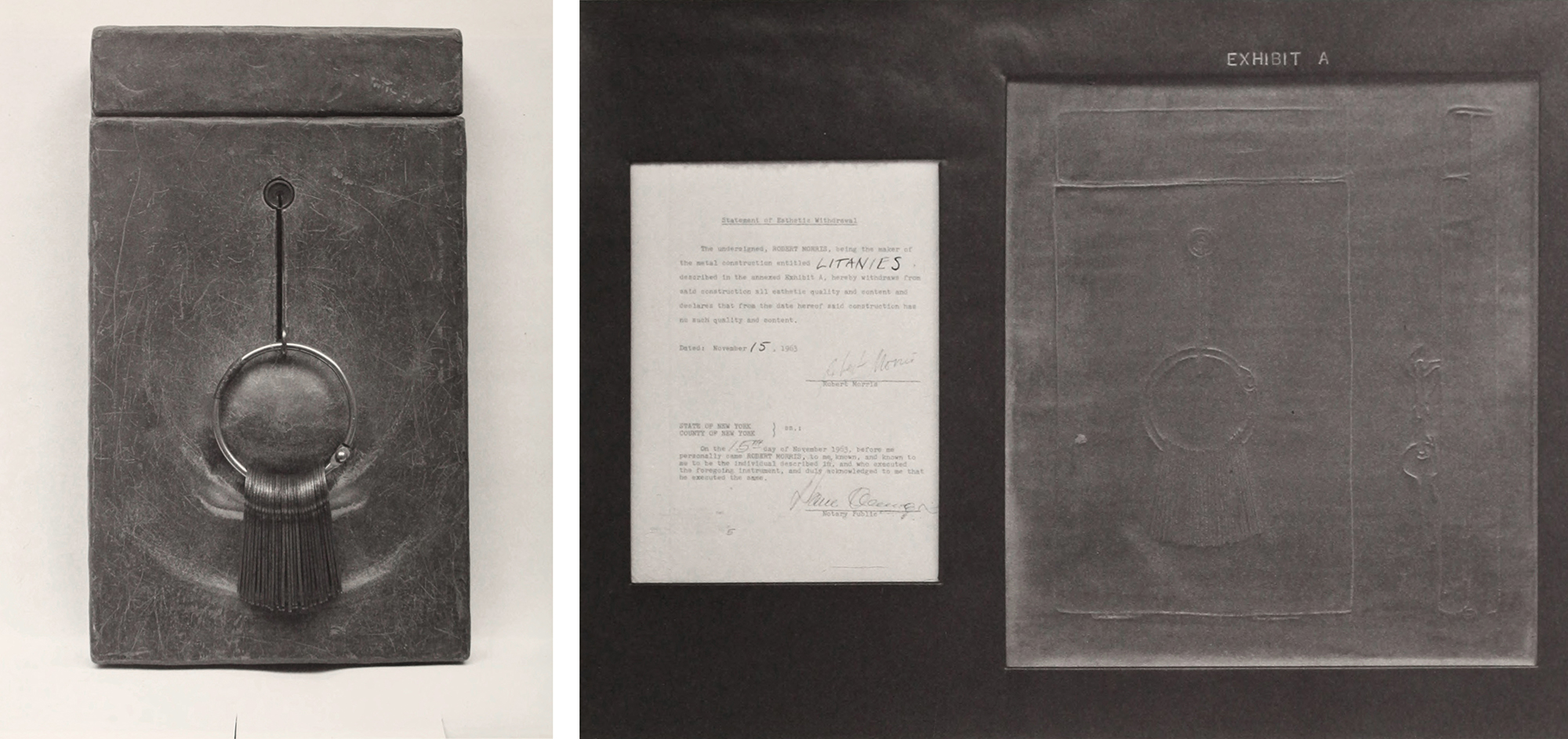
Morris, much earlier, having created Litanies (1963), a lead-over-wood wall piece, bearing a ring hung with twenty-seven keys (each inscribed with a word from a text by Duchamp), riposted to Philip Johnson, who still owed him money for the work, with Document: a legal text ratifying a “statement of aesthetic withdrawal” mounted next to lead-covered “ghost” of the original work [fig. 4a & b]. Can aesthetic qualities indeed be “withdrawn” from a work by an artist’s act of will — as the sacredness of the host is “withdrawn” by an unbeliever?
How might one describe the turn to a baroque aesthetic, indeed a transatlantic “gay baroque”?
Marcel Duchamp’s well-known performance photograph Adam et Eve (1924), posed with his collaborator Bronia Perlmutter during Man Ray’s Ciné-Sketch (1924) was based on a painting by Lucas Cranach: the couple before the Fall. Compare this with Michel Journiac’s Les Substituts6 (1969), a suggested détournement of a fairground alternative: sex-switching, by reversing the heads in the holes above the cut-out naked male and female bodies. The problem of sexual division — to which Duchamp obsessively returned — haunted philosophy from its beginnings, with Plato’s quest for the perfect other half of the separated androgyne. This pain of separation of (Duchamp’s bachelor) implies the problem of love: love as a philosophical problem. Love, homosexual and spiritual would be for Journiac a constant theme. Thrice-married Morris was more neutral.
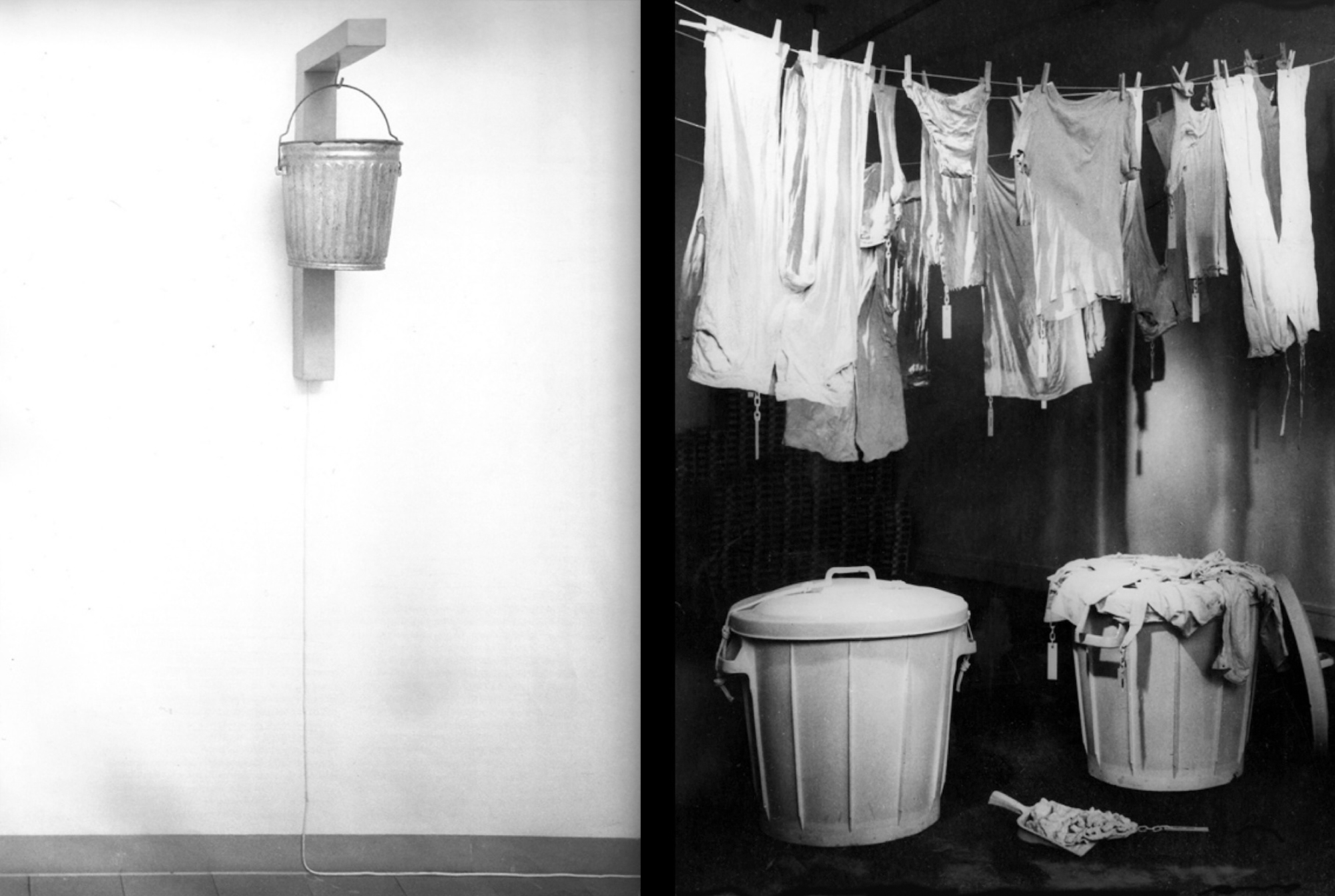
Both Journiac and Morris, used Duchamp’s concept of the “readymade” (notoriously his urinal, Fountain) for their own work: compare Morris’s elevated dustbin, Fountain (1963), and Journiac’s La Lessive (1969) with a similar fluted bin [fig. 5a & 5b]. As we know, Journiac distinguished “saved” artists — on his washing line — and the damned (Salvador Dali, Georges Mathieu) cast into the bin: the abject is represented with minimalism by Morris (is his dustbin empty?) with excess by Journiac, who dipped the clothes of the “saved” into plaster, the traditional sculptor’s material.
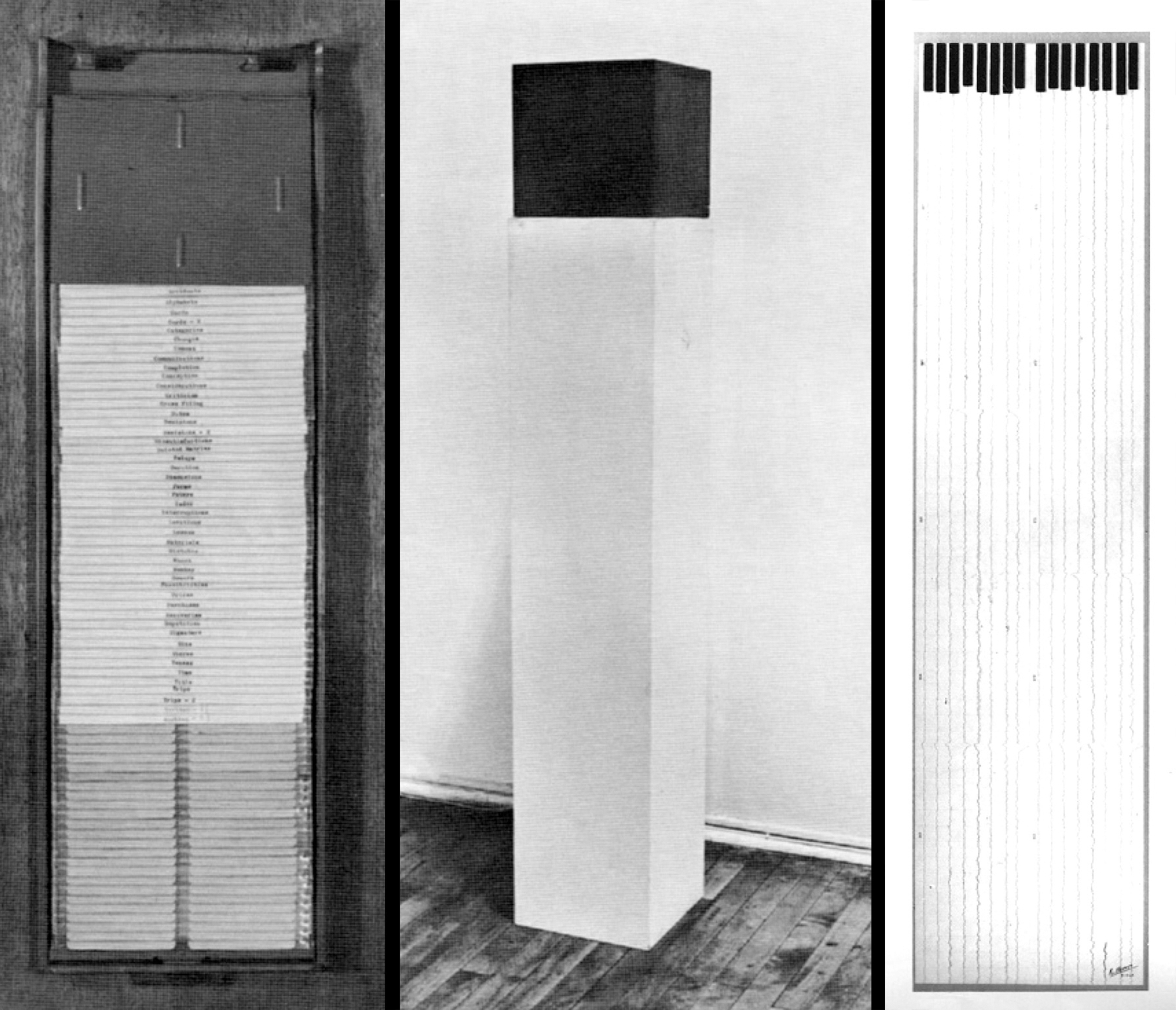
Jorg Heiser, the theoretician of Romantic Conceptualism, claimed that conceptualism (and the “readymade”) mourned the loss of the “beautiful” artwork in the traditional sense. “In Conceptualism, mourning this absence has been successively sublimated into irony, or completely replaced by stern-faced intellectualism.” (Heiser, 2002) Thus Robert Morris’s Self-Portrait (EEG) (1963) [fig. 6c] (the electroencephalogram of his brain activity), like his tautological objects, Box with the sound of its own making, (1961) [fig. 6b] or Card File (1963) [fig. 6a] are “minimal” par excellence, Morris came to Paris in February 1968 for his minimalist sculpture exhibition including his Nine Fibreglass sleeves the Galerie Ileana Sonnabend7. Journiac, in contrast, at the Salon de Mai in the Musée d’art moderne of 1969, already displayed his “stand” (like the stands at the Salon des Arts ménagers ), with his name in neon (pace Joseph Kosuth) and with piles of “Journiac” stickers. He opted for ironic “conceptual” self-promotion, contrasting with Morris’s tautological finesse.
By 1970, New York conceptual doyen, Seth Siegelaub, was operating in Paris via Michel Claura, the go-between for the exhibition 18 PARIS IV.70: eighteen international conceptual artists (no Morris) united by a dialogue of works. On the opening day, 4 April, Journiac held a cheque-signing session chez François Pluchart, the doyen of art corporel (body art) — again following Duchamp (who had died in France in 1968)8.
Journiac’s Hommage à Freud supposes the continual interpenetration of body and mind, not only by a cultural but by a genetic heritage: the combination of nature, nurture and of psyche.
How impersonal is the “I”? Robert Morris’s I-box implicitly posits the post-Cartesian, WASP (“White Anglo-Saxon Protestant”) heterosexual male subject — implicitly the neutral philosophical subject who is autochthonic (not of woman born… despite his navel and sexual appendages). Michel Journiac’s Hommage à Freud : constat critique d’une mythologie travestie9 (1972) — both a poster and a piece of mail art — in contrast, posits the conundrum of the evidently born subject; a gendered, post-Freudian subject, presupposing a critical reading of Freud. Journiac, “dressed up” to resemble his father, Robert Journiac, or his mother Renée Journiac, strikingly resembles both parents: the work supposes a preening in front of mirrors, prior to a preening before the photographic lens — a mirror stage prior to the work of art: a creation all the more ironic if one knows the artificer to be Journiac. Journiac’s Hommage à Freud supposes not only an interpenetration between two beings at the moment of genesis of a third human body – but the continual interpenetration of body and mind, not only by a cultural but by a genetic heritage: the combination of nature, nurture and of psyche. In contrast to Morris’s nakedness or nudity, Journiac posits artifice: the clothes which “construct” man or woman, marking the transition from “bare life” to social being. Here is not only artifice, but travestissement (there is no distinction in French between travesty and transvestism) a meaning that goes both beyond the nature/nurture conundrum, or Foucault’s later concept of “technologies of the self”10. Journiac interrogates the consensus upon which Morris’s I-box is based: “man” as investigator/performer of philosophical truth, its exclusivity and its exclusions. His self-travesty, created in the very year of Gilles Deleuze and Félix Guattari’s Anti-Œdipus (1972), offers a paradigm closer to a philosophical truth about the mind-body problem.
Can aesthetic qualities indeed be “withdrawn” from a work by an artist’s act of will — as the sacredness of the host is “withdrawn” by an unbeliever?
Morris’s hollow, minimalist wooden sculptures had their origin in performance props: Waterman Switch (1965) for example, where he dances naked with Yvonne Rainer, accompanied by Lucinda Childs dressed as a man. “I knew I was on the right track because those plywood pieces were more for the body than for vision. They were more haptic. They had to do with a sense of the body’s presence, and their presence against the body.” (Kitto, 2018) Despite debates around Morris’s “kleptomaniac” progressions of style, one can see his development in the light of Michael Fried’s famous essay Art and objecthood: “the literalist espousal of objecthood amounts to nothing other than a plea for a new genre of theater; and theater is now the negation of art.” ( Fried, 1967). “Theater” involves space, feeling, the emotional spectator: the antithesis of any formalist approach to sculpture.
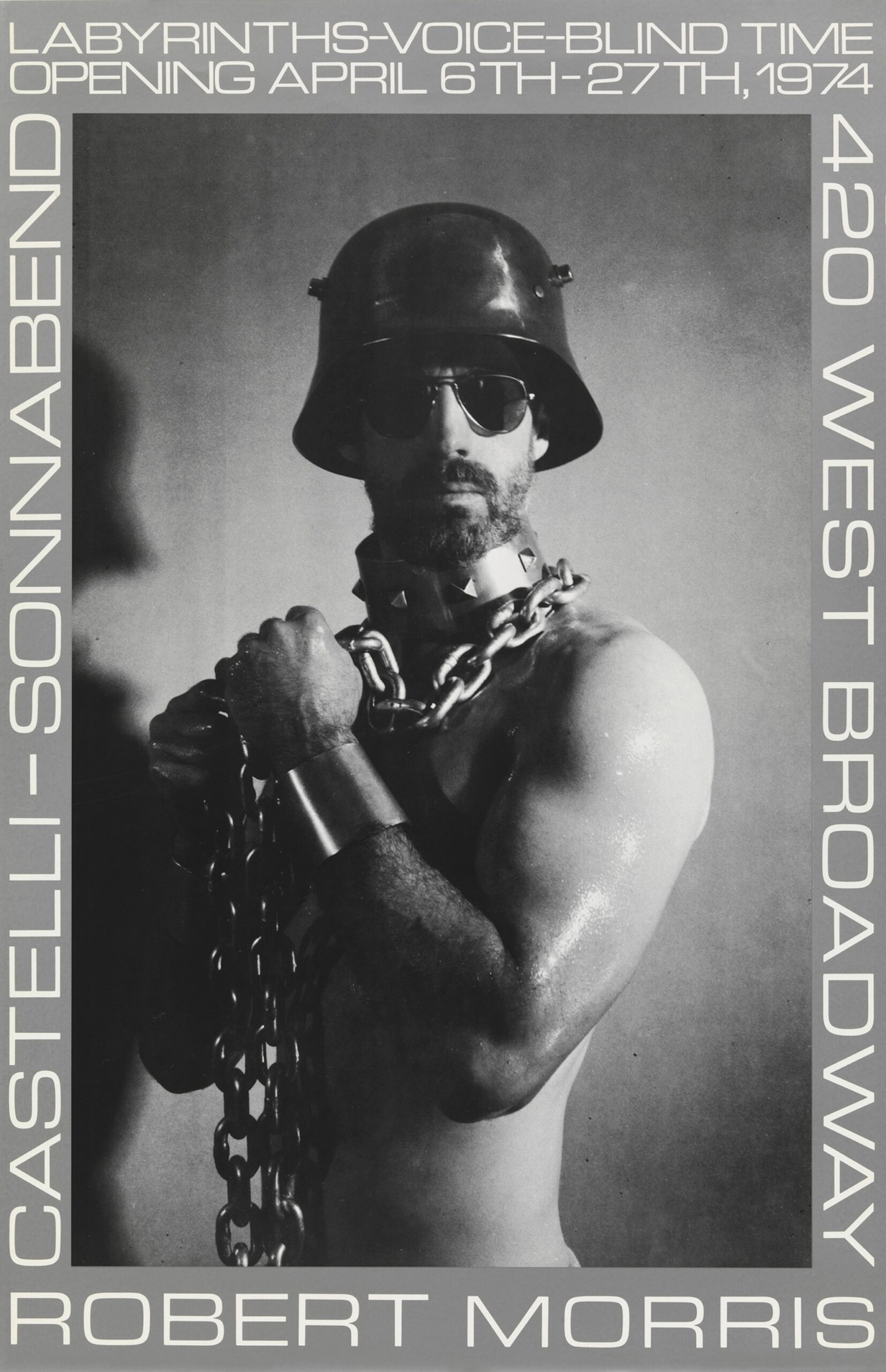
The paradoxical relationship with “queered” performance was echoed later when Morris attempted an unspoken dialogue with the naked, dildo-wielding Lydia Benglis. His muscular self-portrait in chains and a nazi helmet, aviator shades and a spiked neck collar referencing macho (gay) S/M culture, was created as the exhibition poster for “Labyrinths-Voice-Blind Time” at Leo Castelli’s gallery and was reproduced [fig. 7] in Artforum (He retrospectively thought it a great mistake11 [Gilbert-Rolfe, Kapps, 1974; Frost, 2023]). A very public refutation of a “minimalist artist” persona, it was a performative development of his many costume transformations (compare his extravagant outfit for War, 1963, a jousting tournament with the artist Robert Huot, at the Judson Memorial Church). One thinks of the extraordinary costume permutations in Journiac’s 24 heures series (1974), especially the night-time fantasy sequences [fig. 8].
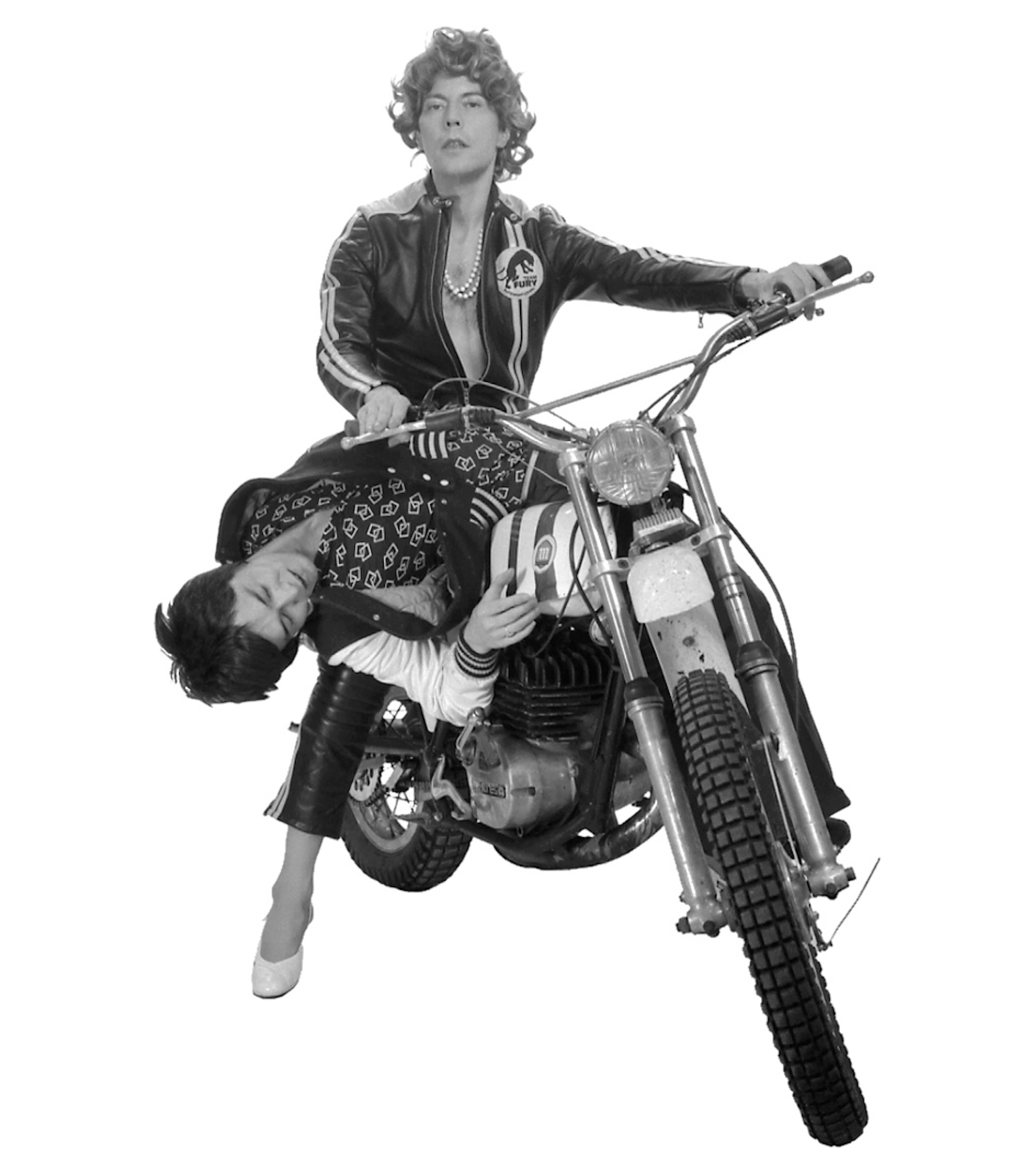
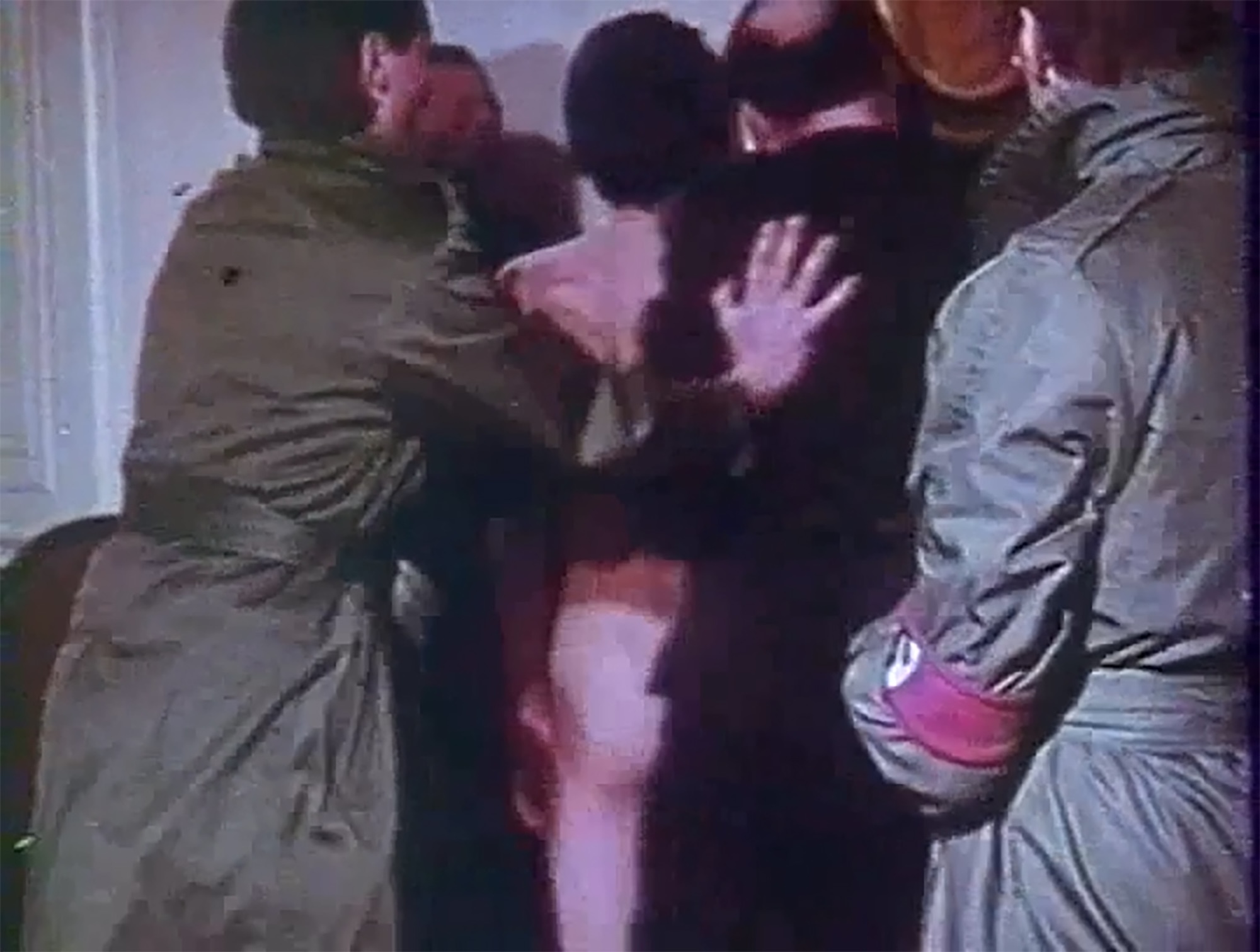
Morris’s pseudo-nazi episode may be compared with Journiac’s unexpected “nazi” adventure. Journiac participated in an episode of the late Lionel Soukaz’s film of 1979 based on Guy Hocquenghem’s Race d’Ep (verlan — inverted gay slang — for “race of pederasts”12). Clad in the very same trench coat used for his appearance as fils-voyeur13 in the series L’Inceste (1975), but with an SS armband, Journiac participates in the second episode of the four-part film: within a group, he storms Magnus Hirschfeld’s Institute of Sexual Research in Berlin and manhandles a naked hermaphrodite [fig. 9]. The film progresses to the autodafé of Hirschfeld’s books: pioneering studies of homosexuality, bisexuality and transvestism14. The smoke of the autodafé segues into the fog surrounding a concentration camp. The film makes the link between the joyous sexual liberties of the Berlin cabaret world of the 1920s and the Holocaust: the same protagonists, it is implied, would perish in the nazi genocide (Fernandez, 1978)15. This linkage was central for Journiac: notably his performance Marquage: Action du corps exclu at the Centre Pompidou in 1983, where he branded his own flesh with the triangle — the nazi sign for the homosexual — when the impact of AIDS was accelerating.
How might one describe the turn to a baroque aesthetic, indeed a transatlantic “gay baroque”? The extravagances of lyrical abstraction had spurred a so-called “baroque” in the early 1960s (Tapié, 1965)16. The après-mai des faunes17 (Guy Hocquenghem’s title) had given birth to a softer, androgynous male, celebrated at the Transformer: aspects of travesty exhibition in Lucerne, in 1974. The “Schizo Culture” conference bringing French thinkers to New York in 1975 marked a high point of exchange18. Charged with post-1968 melancholy and in a context of economic crisis, irony and self-irony progressed. In the same year as Jacques Lacan’s Encore (1975), elaborated topologies of jouissance under the sign of Bernini’s Saint Teresa in Ecstasy, ORLAN’s Strip-tease occasionnel avec les draps de trousseau19 was created, anticipating her baroque Vierge noire series of 1983, while her friend Christine Buci-Glucksmann published La raison baroque in 1984, four years before Gilles Deleuze’s famous Le Pli, Leibnitz et le baroque20 of 1988. Michel Foucault’s turn from the analysis of society’s disciplinary structures to his explorations of homosexuality and L’Usage des Plaisirs21 (1984), may be framed as part of the same baroque turn, with its self-care focus, active within a newly-defined post-modern condition: a condition which reverberated in Paris, New York or Foucault’s San Francisco (Lyotard, 1979).
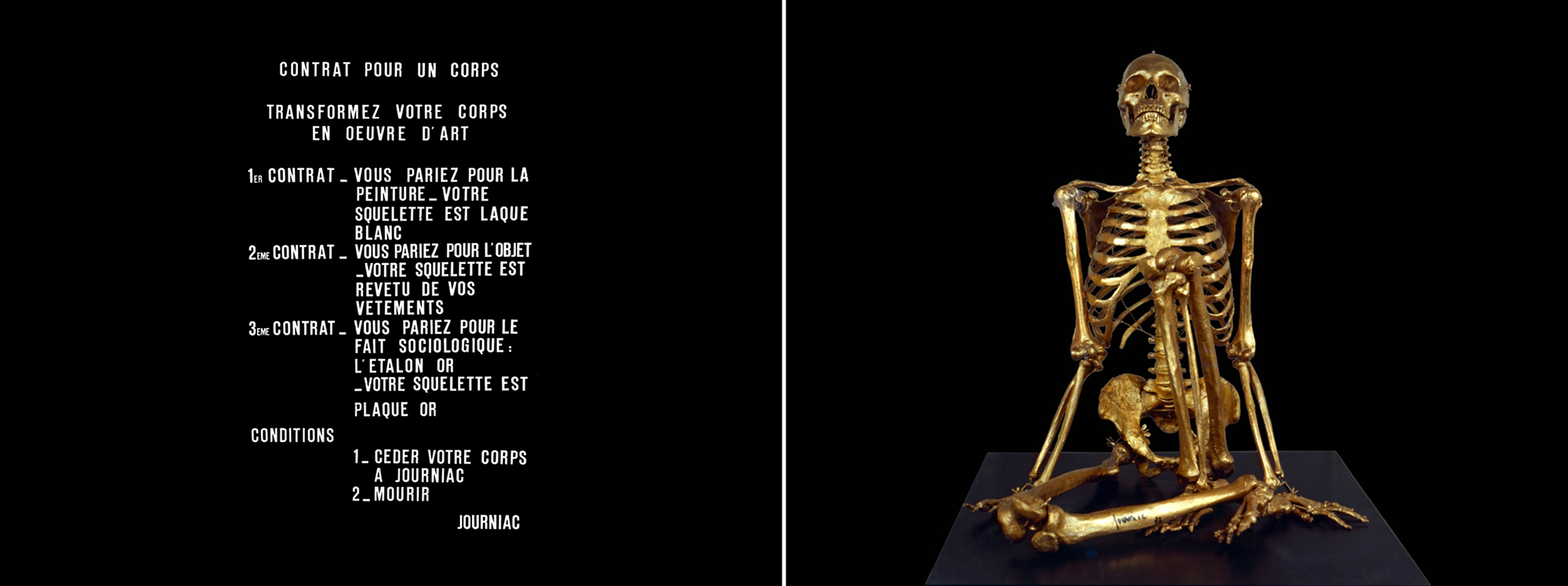
Within this increasingly entangled context, where shared fashions, music and air travel blurred philosophical and cultural distances, both Journiac and Morris turned to gold. Journiac was never entirely distanced from the trappings of the Catholic church, where the Counter-reformation gilded its message with curving, light-capturing forms. Contrat pour un corps No. 3 (1972) [fig. 10] took the notion of the conceptual art contract, and transformed the body, reduced to a skeleton, into a ready-made work of art, lacquered white for painting adepts, gold plated for the followers of l’art sociologique22. The gold skeleton, seated, one knee upright, is the artwork23.
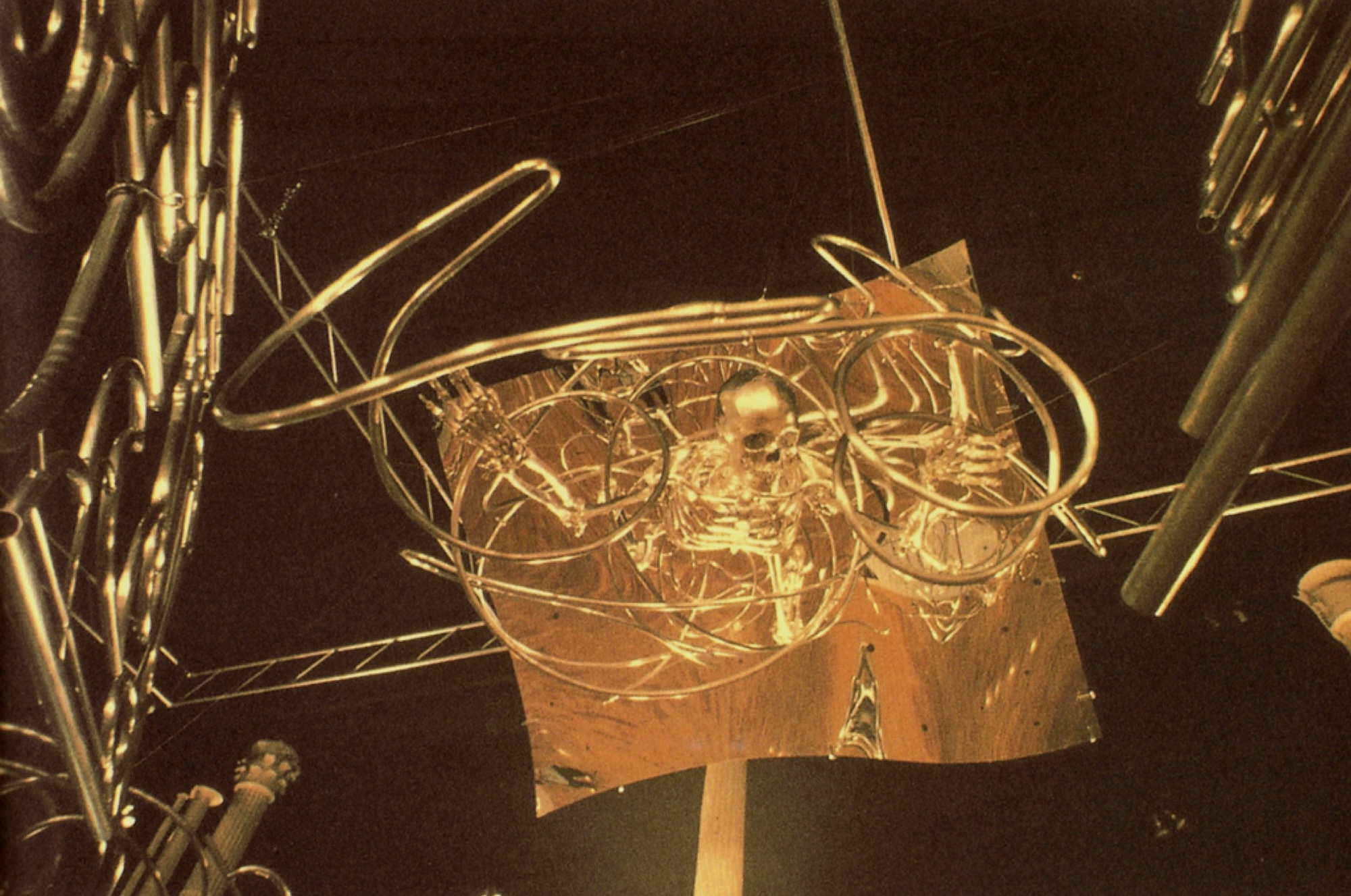
Morris’s First Study for a view from a corner of Orion (Day) (1980) [fig. 11] is his silver-plated equivalent. Rachel Stella has described how these Studies (Day and Night) were preceded by an installation of skulls suspended in front of illuminated onyx slabs in a blacked-out room (Preludes for A.B.).
[Then] Steel trusses, stones, light fixtures, felt, aluminium tubing, and mirrors are placed, ostensibly in the formation of the constellation of Orion, around, not skulls, but complete human skeletons. In the Day version, the skeletons are silver-leafed (apparently gold in installation photographs); the Night version contains a single black skeleton in a pose taken directly from Bernini’s Tomb of Alexander VII, and likewise holding an hourglass (Stella, 2015).
Just as Preludes, with eight texts accompanying eight slabs and eight skulls described funerary monuments, so Study for a View from a Corner of Orion is incontestably a memento mori. Stella discusses death, ekphrasis, kitsch. Carter Ratcliff later interprets the festoons of black felt in the Night version as post-atomic toxic clouds24.
Journiac’s Contrat pour un corps, presupposed human death prior to the possibility of its execution: his gold skull grins, challenging and triumphing over the kitsch of contemporaries such as the painter Georges Mathieu. Irony now overlays his earliest theological apprehensions. Morris, horrified as a child with his father’s job linked to the slaughtering of cattle (later interpreted as a premonition of the Holocaust), and politicised within the field of 1960s and 1970s American protests, took his baroque mode into the air, the realms of the angelic.
Both artists, intellectuals, were unafraid of extreme experiment, both pushed the boundaries of the acceptable, morally, spiritually, visually…
Both men created moving work in honour of their friend’s deaths from AIDS. In a New York with its artworld ravaged, Morris’s black and silvery Lungs for Adam Buchsbaum (1987), (a very prominent designer) speaks across time and space to Journiac’s Rituel initiatique25 (1983), his Rituel de Transmutation, la monnaie du sang26 (1993), and his commemorative work, the Mur des amis morts27 (1993). The gold of the baroque was also present in one of his last actions, the creation of a magnificent triptych Action, 150 poèmes mis au sang28, on 6 March 1993 at the Paris book fair, filmed by Lionel Soukaz: three gold panels, three wounds, the blood drawn from his arm) were inscribed with the words “Hormis tout cela il y a Jésus Christ / qui n’entendait rien aux finances / et, paraît-il, n’avait pas de bibliothèque…” [“Beyond all that, there’s Jesus Christ who understood nothing about finance and apparently had no library…”]
While AIDS brought international and art communities together, Journiac remained in an intensely Catholic tradition; Morris remained in limbo with his art of the memento mori — predicted so early when his wooden boxes became coffins (see Untitled, Rough Tombstone, 1969). The Hydrocal reliefs of 1982, where a notional dialogue with a welter of historical styles in dark frames and content verged on “Halloween spookiness”, were perceived as veritably embarrassing in his retrospective (Ratcliffe, 1985). Both artists, intellectuals, were unafraid of extreme experiment, both pushed the boundaries of the acceptable, morally, spiritually, visually, and in terms of the boxes with which art historians wish to frame the “I” (the “mind-body problem”) of others retrospectively.
Would it not be splendid to bring their works together in a major retrospective?
References
Amman, J.-C. (Éd.) (1974). Aspekte der Travestie. Lucerne. Kunstmuseum Lucerne.
Art & Language (1976). “The French Disease”. Art-Language Fox 3, 4, October, 23–34.
Bartet, C. (Éd.) (1966). Ludwig Wittgenstein. Lectures & Conversations on aesthetics, psychology and religious belief. Oxford. Blackwell.
Beurdeley, C. (1977). Beau petit ami. Fribourg. Office du Livre.
Buci-Glucksman, C. (1984). La raison baroque de Baudelaire à Benjamin. Paris, Galilée.
Cahiers de Royaumont (1962). La philosophie analytique. Paris. Les éditions de Minuit.
Claura, M. (Éd.). 18 Paris IV. 70. New York. Seth Siegelaub (International General).
Deleuze, G. (1988). Le Pli. Leibnitz et le baroque. Paris. Les éditions de Minuit.
Deleuze, G. (1992). The Fold. Leibnitz and the Baroque. University of Minnesota Press.
Deleuze, G. & Guattari, F. (1972). Capitalisme et schizophrénie 1 : L’Anti-Œdipe. Paris. Les éditions de Minuit.
Deleuze, G. & Guattari, F. (1983). Capitalisme et schizophrénie 1: L’Anti-Œdipe. University of Minnesota Press.
Fernandez, D. (1978). L’Étoile rose. Paris. Grasset.
Foucault, M. (1988). “Technologies of the self”. In Hutton, P.H., Gutman, H., and Martin, L. H. (Éd.). Technologies of the Self. A Seminar with Michel Foucault. Anherst. The University of Massachusetts Press, 16-49.
Fried, M. (1967). “Art and Objecthood”. Artforum, 10 (5), June, 12–23.
Gilbert-Rolfe, J. (1974). “Robert Morris: The Complication of Exhaustion”. Artforum, 1 (13), September, 44–49.
Heiser, J. (2002). “Emotional Rescue”. Frieze, 11, November, 70–75. https://www.frieze.com/article/emotional-resc
Hirschfeld, M. (1904). Berlins Drittes Geschlecht. Berlin. H. Seemann.
Hirschfeld, M. (1908). Les Homosexuels de Berlin : le troisième sexe. Paris. Jules Rousset.
Hocquenghem, G. (1974). L’après-mai des faunes : Volutions. Paris.Grasset.
Hocquenghem, G. (1979). Race d’Ep!. Paris. Éditions Libre / Hallier.
Journiac, M. (1972). Contrat pour un corps. Paris. Galerie Stadler.
Kapps, K. (2009). “Lydia Benglis / Robert Morris: 1973-1974”. Art in America, July.
Kitto, S. (2018). “The Last interview with Robert Morris”. Interview, December. https://www.interviewmagazine.com/art/the-last-interview-with-sculptor-robert-morris
Krauss, R. E., and al. (1994). Robert Morris, The Mind/Body Problem [exhibition catalogue]. New York. Solomon R. Guggenheim Museum. https://ia800608.us.archive.org/19/items/robertm00morr/robertm00morr.pdf
Lacan, J. (1975). Encore. Paris. Seuil.
de Loisy, J., Restany, P., and al. (1994). Hors limites : l’art et la vie, 1952-1994 [exhibition catalogue]. Paris. MNAM, Centre Georges Pompidou.
Lyotard, J.-F. (1979). La condition postmoderne, rapport sur le savoir. Paris. Les éditions de Minuit.
Lyotard, J.-F. (1984). The Postmodern Condition: A Report on Knowledge. University of Minnesota Press.
Mitchell, W. J. T. & Morris, R. (1994). “Golden Memories”. Artforum, 8 (32), April.
Morris, R. (1968). Robert Morris. Paris. Galerie Ileana Sonnabend.
Morris R. & Cummings, P. (1968). “Oral history interview with Robert Morris, 1968 March 10”. Archives of American Art. Smithsonian Institution. https://www.aaa.si.edu/collections/interviews/oral-history-interview-robert-morris-13065
van Peursen, C. A. (1966). Body, Soul and Spirit: a survey of the mind-body problem. London and New York. Oxford University Press.
Pluchart, F. (31 mars 1970). “Communiqué”. Paris.
Ratcliffe, C. (1985). “Robert Morris. A Saint Jerome for our times?”. Artforum, 8 (23), April, 60–63.
Stella, R. (2015). “When Kitsch becomes form”. In Investigations. The Expanded field of writing in the works of Robert Morris. ENS Éditions. https://books.openedition.org/enseditions/3812?lang=f2
Tapié, M. (1965). Le baroque généralisé. Turin. Edizioni del Dioscuro.
- I lectured on both artists in “Body-Conceptual, Body-Spectacle, Michel Journiac and Robert Morris” for the Tate Modern London conference, “Expanded Conceptualism” which I organised with Boris Groys and curator Nicholas Cullinan, 22 August, 2011. [Retour au texte]
- Exhibition from January 15 to May 1, 1994 at the Solomon R. Guggenheim Museum (New York). [Retour au texte]
- Exhibition from November 9, 1994, to January 23, 1995, at the Centre Georges Pompidou (Paris). [Retour au texte]
- See the fourth Colloque international philosophique international de Royaumont, 8-13 April, 1958, where the Americans, Willard Quine and Alan Gewirth joined Oxford philosophers J.L. Austin, A.J. Ayer , with Jean Wahl, Maurice Merleau-Ponty, Lucien Goldman, etc. (Cahiers de Royaumont, 1962). [Retour au texte]
- “This is my body” [Retour au texte]
- “The Substitutes” [Retour au texte]
- Nine Fiberglass sleeves were photographed by André Morain for Robert Morris, Galerie Ileana Sonnabend (opening 20 February 1968). Morris confirmed he came to Paris in conversation with Paul Cummings (1968). [Retour au texte]
- See François Pluchart, typed “Communiqué”, about 18 Paris IV. 70, and with his manifesto for Journiac’s action, dated 31 March 1970. [Retour au texte]
- “Hommage to Freud: critical report on a travestied mythology”. [Retour au texte]
- Foucault’s lecture “Technologies of the self” (lecture in Vermont, 1982) is translated as “les techniques de soi”, see http://1libertaire.free.fr/MFoucault192.html [Retour au texte]
- The photograph was taken by Morris’s then lover, Rosalind Krauss ; see https://www.artforum.com/features/robert-morris-the-complication-of-exhaustion-212749, and https://fontsinuse.com/uses/52158/robert-morris-labyrinths-voice-blind-time-exh. In 1994, Morris denounces the image (now a T-Shirt) to W. J. T. Mitchell ; see https://www.artforum.com/features/golden-memories-203157 [Retour au texte]
- Soukaz acknowledged the friendship between Journiac and Guy Hocquenghem (the gay militant who published Le désir homosexuel, 1971) at the Mucem conference. [Retour au texte]
- “Voyeuristic son” [Retour au texte]
- See the book Berlins Drittes Geschlecht (Hirscheld, 1904) ; translated in Les Homosexuels de Berlin : le troisième sexe (1908), and many relevant titles. [Retour au texte]
- See the book L’Étoile rose (Fernandez, 1978). As The Homosexual Century, Soukaz’s film was shown in New York in 1982. For review and cast list see Vincent X , ”Race d’Ep links photography and sexuality”, The New York Times, 19 May 1982, https://www.nytimes.com/1982/05/19/movies/race-d-ep-links-photography-and-sexuality.html [Retour au texte]
- See too Michel Tapié’s series “Baroque ensemblistes”, from 1961-1963 (Alfonso Ossorio, Claire Falkenstein, Iaroslav Serpan and Luigi Moretti). [Retour au texte]
- “After-May of the fauns” [Retour au texte]
- “Schizo Culture” (Columbia University , New York, 13-16 November 1975) was organised by Lotringer and John Rachmann, with Foucault, Lyotard, Deleuze and Guattari. [Retour au texte]
- “Occasional striptease with the Bedsheets” [Retour au texte]
- “The Fold. Leibnitz and the Baroque” [Retour au texte]
- “The Use of Pleasure” [Retour au texte]
- “Sociological art” [Retour au texte]
- See invitation of the exhibition Contrat pour un corps with the contract written in French, English, German and Italian (Journiac, 1972). [Retour au texte]
- Cater Ratcliffe’s essay for Morris’s Leo Castelli show MOLTINGSEXOSKELETONSSHROUD, 2015, inscribes these astonishing late wrapped works in their long trajectory including the Orion works. [Retour au texte]
- “Initiation ritual” [Retour au texte]
- “Ritual of Transmutation, The Currency of Blood” [Retour au texte]
- “Wall of Dead Friends” [Retour au texte]
- “Action, 150 Poems Covered in Blood” [Retour au texte]