
At the outset, and as a continuous thread in this reflection upon Bracha L. Ettinger’s matrixial psychoanalysis and its contributions (both explicit and implicit) to feminist, queer, and transgender studies, I want to allude to several works by the French queer 1 artist Michel Journiac (1935-1995). My aim is to show how my theoretical concerns are always already inscribed within, or stem from, our contingent trans-subjective encounters with Journiac’s artistic practice. Journiac’s artistic practice functions less as an instantiation of theory and more as a visualization of theoretical thinking, prompting us to think alongside it rather than just analyzing it.
“Appearance, which is constantly on the point of passing itself off as reality, must constantly reveal its profound unreality.”
By engaging Journiac as my conceptual “partner-in-difference” — using Ettinger’s term for a relation between two (partial) subjects where connection does not nullify difference — I propose that Ettinger’s matrixial psychoanalysis refrains from becoming a “master discourse.” If it did become one, it would wrongly reduce Journiac’s complex and rich artistic œuvre to a singular, totalizing theory, amounting to a form of intellectual authoritarianism. This reduction contradicts Lacan’s fundamental ethics for psychoanalysis, which insists on refusing a master position to preserve the perpetual questioning of certainties, thus allowing an individual’s unique, unknown truth to emerge (Lacan, 2007). Instead, Ettinger’s theory adheres to this Lacanian ethics by functioning as an “available discourse.” This approach shifts our focus from the potential sources or grounding of human subjectivity and identity and toward the theory’s potential as a vital resource for examining finitude, mourning, and trans-subjectivity in Journiac’s art — a focus most prominent in his concluding ritualistic series (early 1990s), which expanded on concepts he investigated during the 1980s AIDS crisis and had prophetically tested in his early performance art, well before the epidemic began. Stated differently, I am highlighting a form of “encounter-event” between Ettinger’s psychoanalytic theory and Journiac’s artistic practice that institutes “new ways of being in the socio-Symbolic constellation” (Cavanagh, 2022, p. 499). Given that Ettinger’s insights emerge from her own practices as painter, philosopher, and psychoanalyst, we should similarly understand Journiac’s artworks as theoretical texts in their own right — visual articulations of theoretical thinking that confront us with the unbearable thought that we, too, will die.
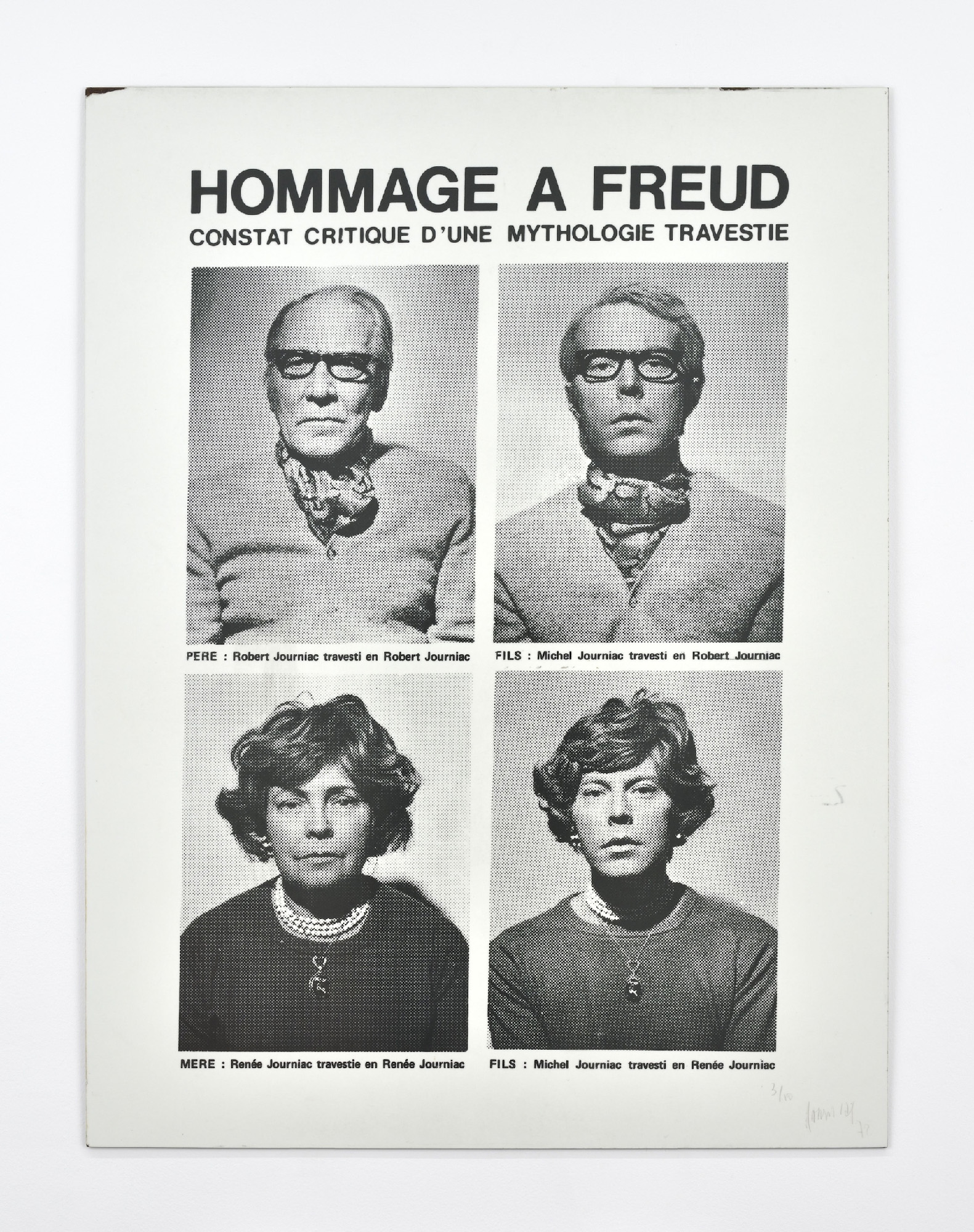
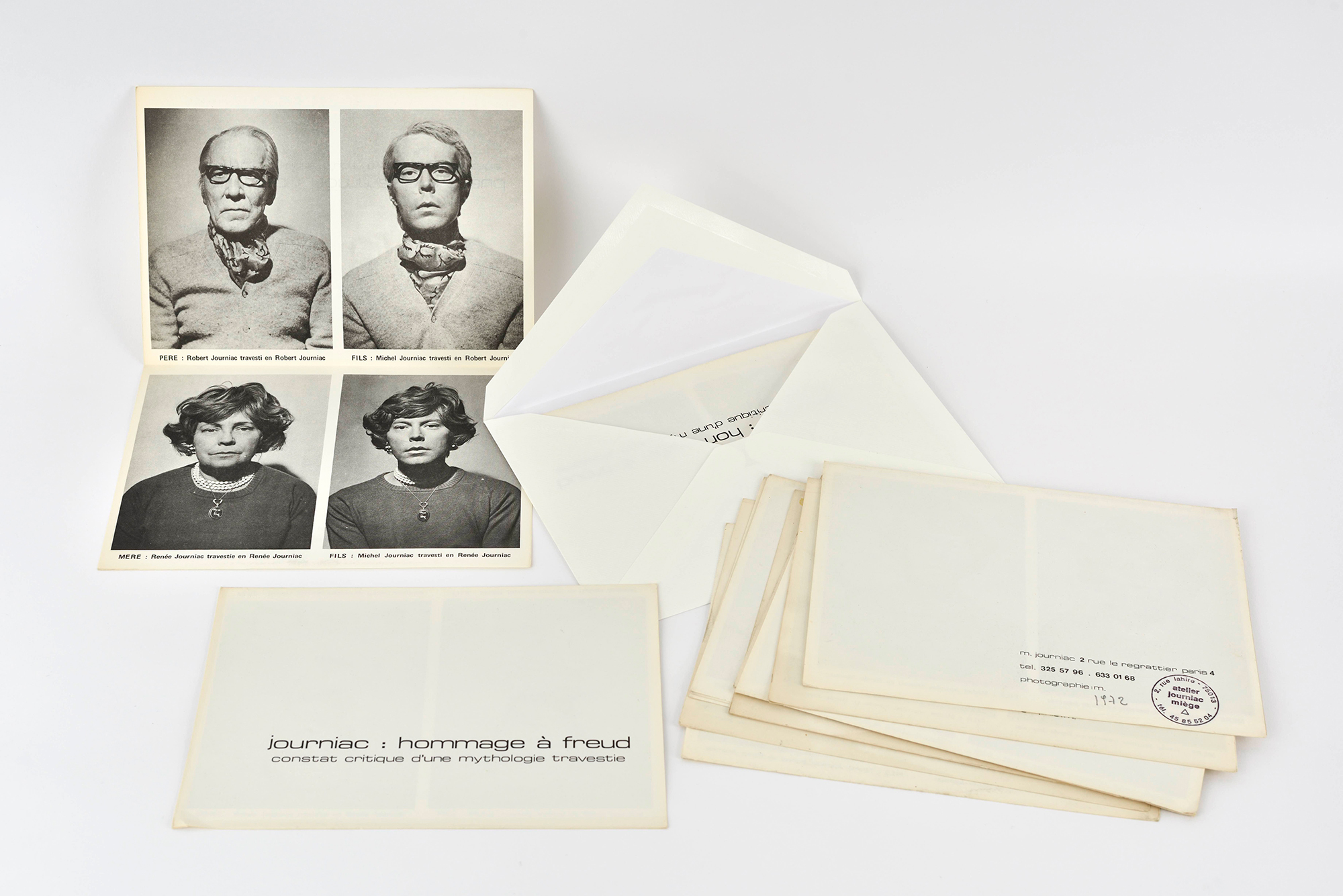
Michel Journiac’s Hommage à Freud: Constat critique d’une mythologie travestie (1972) [fig. 1], originally mounted on a wooden panel but also widely disseminated through the mail — and is thus a clear example of “Mail Art” — features a black and white composite photograph. This photograph consists of four family portraits that simultaneously invoke the representational conventions of bourgeois portraiture and the visual aesthetic of criminal mug shots. The upper left presents the father, Robert Journiac, travesti en Robert Journiac. His attire — woolen jacket, glasses, grey hair, neck scarf — and serious gaze epitomize the “normal” visible features of a lower-middle-class man performing his masculine role as the father or family patriarchal figure. Conversely, the upper right displays the artist, Michel Journiac, travesti en Robert Journiac, adopting his father’s exact clothes, complements, and hair. This act of repetition highlights the citational nature of gestures, which, as Samuel Weber observes, paradoxically relies on “the irreversible irruption of singularity”:
[there is a] transformation of repetition from a process aimed at reproducing identity to one that allows for the aporetical resurgence of the singular: aporetical because the singular as such is not identically repeatable, reproducible, unique — but its uniqueness is also not separable from a certain repetition. Such repetition “produces” the uniqueness of the unrepeatable in the form of those unexpected, often uncontrolled movements. (2006, p. 73)
This framework implies Journiac’s repetition is not merely a restatement of the Same but a creative power that generates difference. His imitation of his father thus functions as the actualization of a virtual simulacrum rather than the repetition of a past one. The lower left panel introduces the mother, Renée Journiac, travestie en Renée Journiac. Her hair, which is in fact a wig worn following a period of illness, pearl necklace, medal, and simple woolen sweater underscore a lower-middle-class aesthetic, pointing to an unfamiliarity with the conventions for a photographic “immortalization” of French bourgeois women. Finally, the lower right features Michel Journiac again, this time travesti en Renée Journiac, wearing his mother’s precise hairstyle and feminine attire, though his pose maintains a more conventional rigidity for a bourgeois family portrait. Journiac’s embodiment of his mother’s subjectivity and housewife identity echoes Jean-Paul Sartre’s observation regarding the ontological instability of appearance: “appearance, which is constantly on the point of passing itself off as reality, must constantly reveal its profound unreality” (Sartre, 1954, p. 10). Discussing Jean Genet’s Les Bonnes (1947), Sartre highlights that the fluidity between appearance and being problematizes ontology, which is inevitably dependent on non-being (1954, p. 30). This leads to a theory of ontological relatedness wherein the self and the other are mutually implicated, bearing witness to the impossibility of fully being either. Journiac’s simulacral incorporation of the maternal figure resonates with the emphasis in Les Bonnes on “processes of constant folding and unfolding of experience. There are no fixed centers […]; instead, bits and pieces are constantly moving in and out of the folds to become intertwined with other surrounding unfoldings in a ‘spiraling distributive process’” (Hequembourg, 2007, p. 158). By emphasizing an ambivalent and interminable process of deferrals, substitutions, and supplements, Journiac proposes a form of being and ontological relatedness that actively disrupts the metaphysics of presence — the tradition in which “being” is understood as “presence” (Debevec Henning, 1982, p. 231). This shift from stable centers to endless, belated movement (from presence to absence, identity to difference) is precisely what Jacques Derrida describes:
Everything begins with reproduction. Always already: repositories of a meaning which was never present, whose signified presence is always reconstituted by deferment, nachträglich, belatedly, supplementarily: for nachträglich also means supplementary. The appeal of the supplement is primal here and breaks open what will be reconstituted by deferment as the present. The supplement, which seems to be added as a plenitude to a plenitude, is as well that which compensates for a lack. (1972, p. 92, emphasis in original)
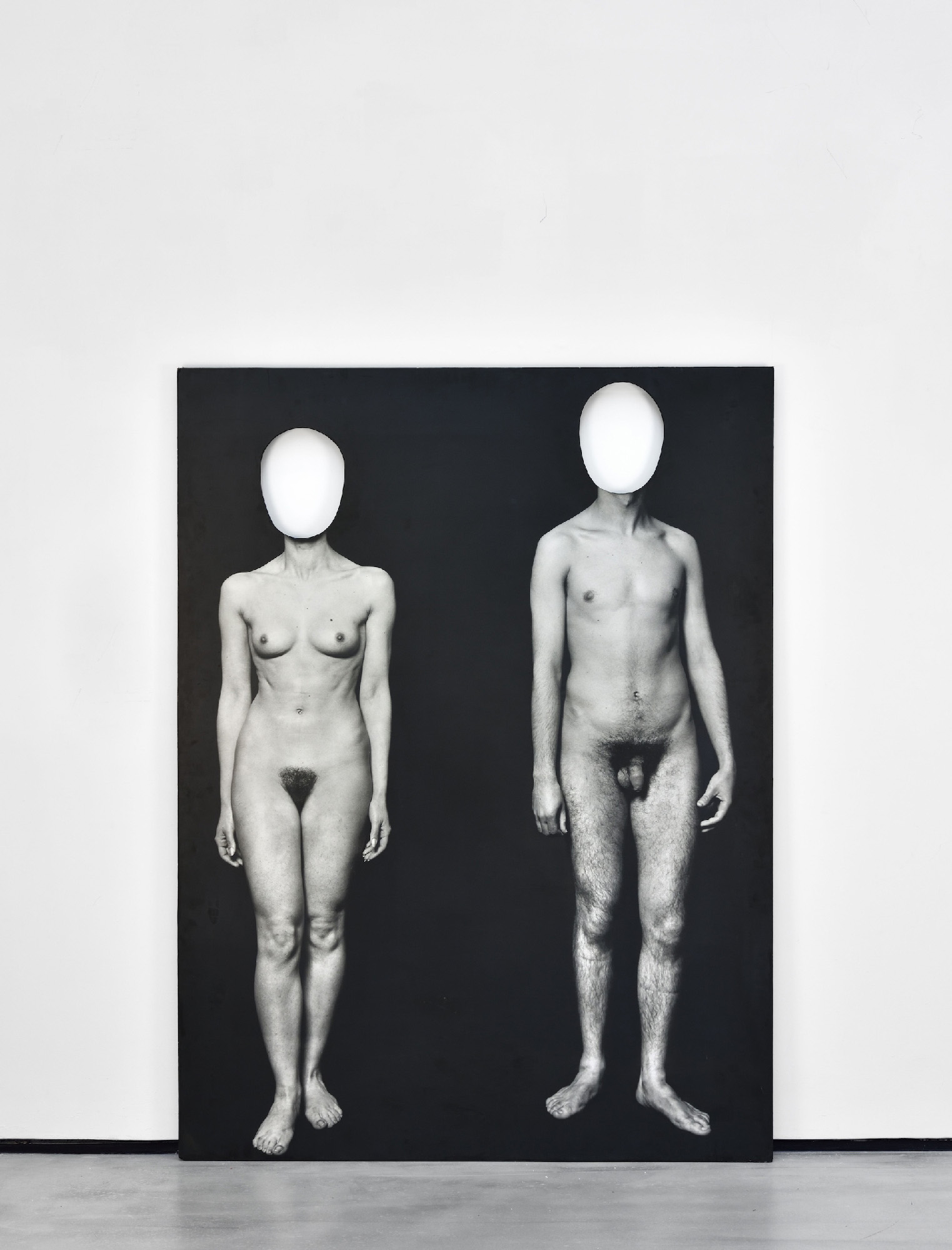
Journiac’s photograph emphasizes or unveils both the artificial foundation of ontological categories within patriarchy and heteronormativity, and the asymmetrical differences between and within these subjects at a transgenerational level, thereby accounting for the other in the other and the other in the self. Journiac’s focus on alterity resonates with Julia Kristeva’s categories of strangeness — the external stranger, the internal stranger within society, and one’s own self-estrangement — a concept tied to the semiotic realm that the self experiences despite its inaccessibility (1991). This idea is strikingly enacted early on in Journiac’s 1969 photograph, Les Substituts [fig. 2], mounted on a wooden panel, which features two full, naked figures, one anatomically male and one female, but with their faces circularly excised to remove individual expression and recognition, allowing the figures to not only accept the other’s nakedness but also to seemingly exchange their very nudity (Docquiert, 2017, p. 14).
This emphasis on the alterity of the other within the self and the self within the other also dramatically aligns with Bracha L. Ettinger’s concept of the matrixial borderspace, which, diverging from Deleuze and Guattari (a point to which I will return) posits a cluster of several partial subjects. These subjects are neither symbiotic nor fully separate, neither completely known nor completely un-cognized, with one partial subject neither fully assimilating nor fully rejecting the other. Ettinger argues these partial subjects are best understood through borderlinking, a process wherein subjectivity renders itself fragile in the encounter-event. In this matrixial space, this fragility is not a weakness but a site of recognition:
We thus metabolize mental imprints and traces for one another in each matrixial web whose psychic grains, virtual and affective strings and unconscious threads participate in other matrixial webs and transform them by borderlinking in metramorphosis.
(Ettinger, 2005, p. 705)
This implies a profound transformation of the shared psychic web.
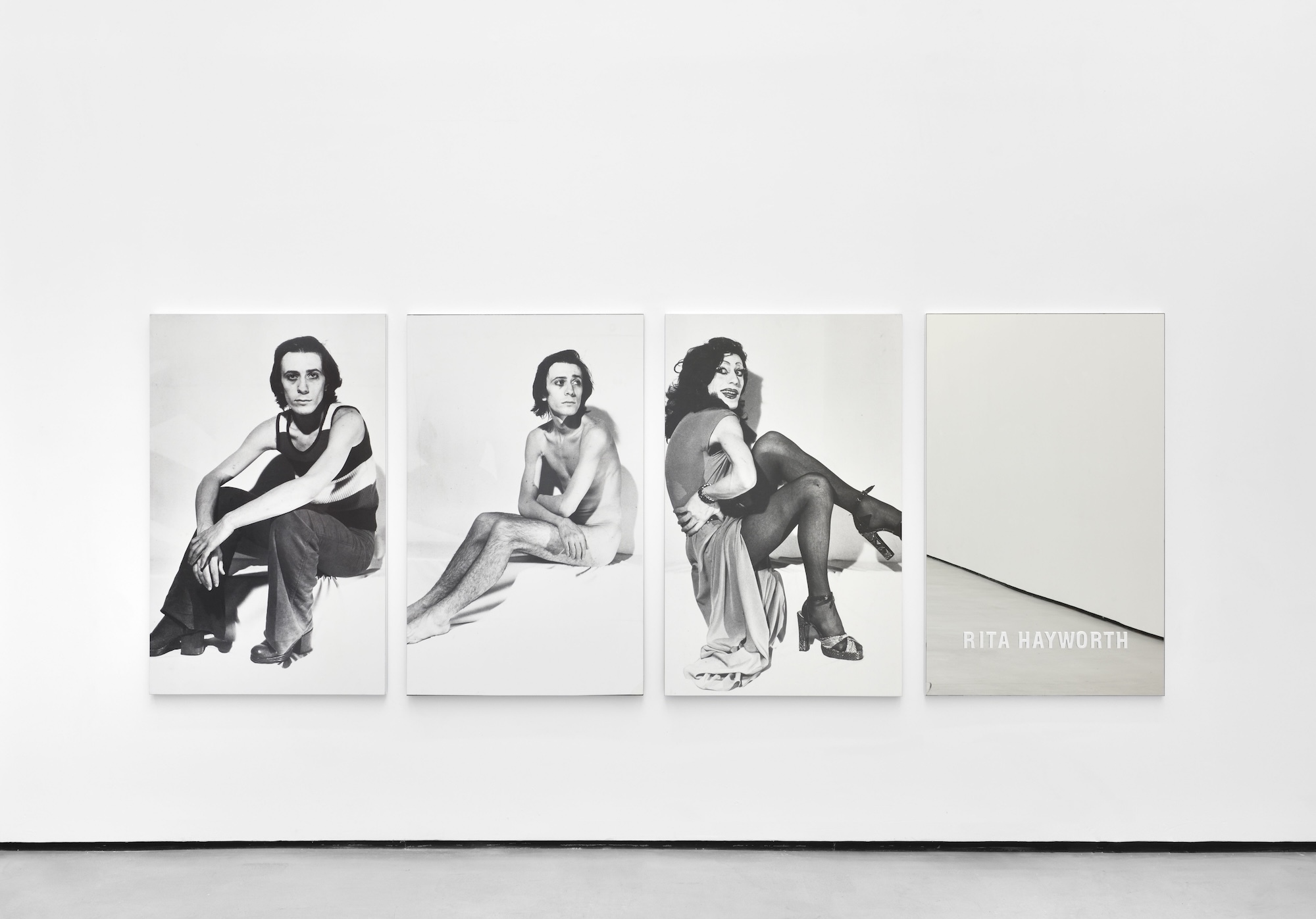
Journiac thus conceives trans-subjectivity within and beyond transgender identity. Trans-subjectivity within transgender identity is strikingly evident in Journiac’s photographic series, Piège pour un travesti [fig. 3], which features large, multi-panel photographs of Jean-Paul Casanova mimetically reproducing feminine gestures to impersonate various female divas like Greta Garbo or Arletty, or — an example of which is the panel Piège pour un travesti: Rita Hayworth (1976) included in this article. Casanova’s mimetic inscription of feminine gestures here simultaneously reproduces and undermines cultural norms, pointing to their potentiality derived from their inherent fragility and mutability (Dickinson, 2011). Crucially, Journiac incorporates a panel in each series of photographs that operates as a mirror for the viewer, its reflected image either aligning with or deviating from the other figures, yet invariably underscoring the artificial, cosmetic conditions of the bodily self (itself). Whether seen in the mirror or not, our body exists at an ambivalent nexus between being a depthless surface and constituting the material (flesh and blood) and discursive conditions (sociological and ritualized body) of the subject. This configuration illuminates the body as always already prosthetic, implying that the prosthetic is integrated into the body, which functions as the medium for our internal and external relations; following Freud, the body is a “projection of a surface” that mediates the relationship between the outside and the inside of the self (1962 [1923]). The mirror in Journiac’s Piège pour un travesti thus acts as a technology, a supplement to human embodiment, which problematizes — or even disarticulates — the relationship between the natural and the artificial, exposing technology and the prosthetic as the condition of possibility for the constitution of embodied subjectivity. This directly challenges the binary opposition between the “prosthetic” and the “natural.” Casanova’s assimilation and (re)production of feminine gestures — aimed at impersonating female divas like Garbo, Arletty, or Hayworth — is driven by a distinct intentionality; yet these corporeal movements also complicate this instrumental purpose. Engaging with Agamben’s theory, Jill Bennett contends that the gestures resist a constricted teleology, interpretable not as “the means of addressing an end, nor an end in itself […] but ‘the process of making a means visible’” (Bennett, 2007, p. 436), thereby unmaking their own instrumentalization. Furthermore, these feminine gestures function as parodic signifiers, connoting an excessive investment in the performance of feminine identity through the artifice of clothing and the expressive, identical, and singular feminine gesture. As a non-linguistic form, this gestural mode mediates physical and emotional experiences precisely where signifying language fails, occupying an ambivalent position between the communicative and the introspective (Bennett, 2007). Crucially, the gesture surpasses mere communication; it self-reflexively expresses its own “being-in-a-medium” (Agamben, 2000). This suggests a “non-communicative speechlessness” existing beyond the limits of language, given that corporeal movements are fundamentally predicated on their own mediality. Consequently, gestures actively interrupt language precisely at the moment of its manifestation (ten Bos, 2005, p. 40).
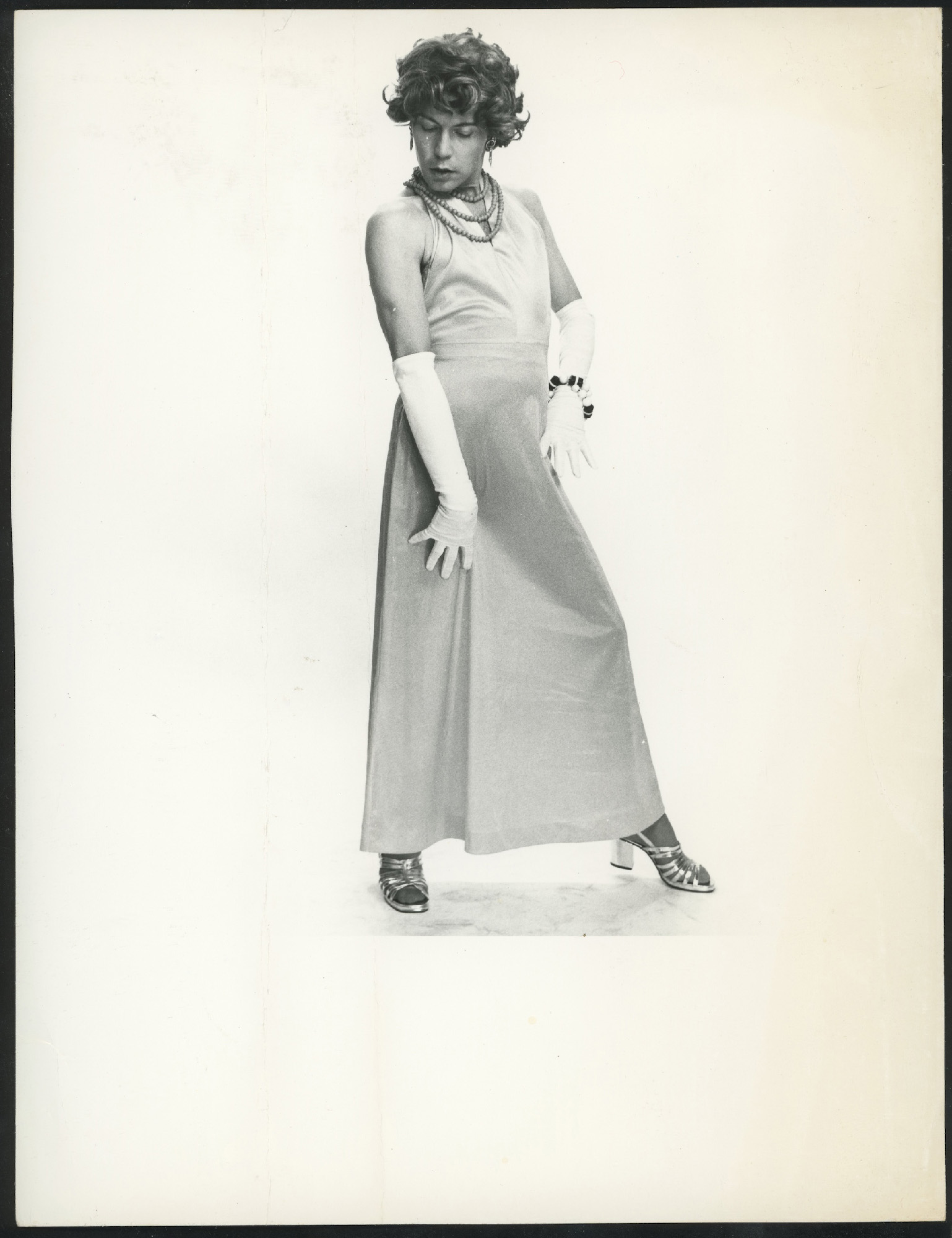
Journiac’s exploration of trans-subjectivity beyond mere trans-gender identity aligns with Ettinger’s concept of a sexual difference that transcends both gender identity and the constraining Oedipal, phallic binary opposition of masculinity and femininity. Regarding the critique of gendered femininity itself, this is most evident in Journiac’s sustained engagement with the 24 heures de la vie d’une femme ordinaire project, which spans from its 1974 origins to its ritualistic re-iterations in 1994-95. In these works — including the Fantasmes series and specific iterations like La Covergirl (version 3) (1974) [fig. 4] — Journiac employs an elaborate form of cross-dressing modeled after idealized figures in women’s magazines to enact the daily rituals associated with feminine existence. These performative actions serve as a profound sociological reflection, illustrating how the female subject is biopolitically conditioned and consequently trapped by hierarchical discourses governing class, gender, and sexuality. By embodying both his own anxieties and cultural fantasies projected onto the female form, Journiac critically exposes the constructed nature of this subjugation. Yet, to underscore the affective intensities that dissolve and rupture the feminine body’s discrete, contingent construction and strictures — bound by heteronormative, patriarchal, and phallocentric systems — through an emphasis on trans-subjectivity in Journiac’s work, we return to Hommage à Freud to contend that Journiac moves beyond what he understood as the orthodox psychoanalytic trap to instead evoke Ettinger’s conception of the feminine in human subjectivity. Journiac’s photographic action visually performs the matrixial subject structured by what classical psychoanalysis excludes from its Oedipal narrative, thereby enacting Ettinger’s theoretical project. The work avoids the purely anti-Oedipus perspective of endless fragmentation, offering instead a visualization of Ettinger’s notion of the Feminine: thinking the feminine from within the feminine. Every subject, regardless of assigned sex and gender, is always already connected to a sexual difference of the Feminine beyond the phallus. This Feminine is less about a fixed gender identity — where the archaic feminine figure might even align with a trans man with a uterus — than about transitivity within Ettinger’s matrixial borderspace. This point is reinforced by the fact that many trans men do not regard their anatomy as female, supporting the argument that the matrixial Feminine, while potentially linked to female corporality, cannot be reduced to it. In this context, this other “axis of difference” paradoxically becomes a crucial resource for “trans-feminine people” (Cavanagh, 2022).
Whether seen in the mirror or not, our body exists at an ambivalent nexus between being a depthless surface and constituting the material (flesh and blood) and discursive conditions (sociological and ritualized body) of the subject.
Following the May 1968 revolts, new political, intellectual, artistic, and social movements emerged, fundamentally reshaping key theoretical and political concerns in a bid to revolutionize society and sexual politics. These efforts actively contested the cultural stability, authority, and order imposed by the prevailing French bourgeois society. It was within this fertile environment that Journiac’s photograph was produced in 1972, the same year that Deleuze and Guattari published Capitalisme et schizophrénie 1 : L’Anti-Œdipe, and Guy Hocquenghem published Le désir homosexuel. Turning to the former, Deleuze and Guattari mounted an immediate challenge to the Freudian and Lacanian preoccupation with lack, castration, and the centrality of the phallic signifier. They criticized psychoanalysis for its reductive focus on the nuclear family structure. While they did not entirely renounce the psychoanalytic framework — significantly, Guattari was trained by Lacan and remained affiliated with the École Freudienne de Paris well after 1972 — they devised a theory of desire that transcended the “privatized,” isolated mind of the Freudian Oedipal triad. Their machinic concept of desire avoided binary exclusions and, unlike the Lacanian model, functioned independently of lack. Consequently, the subject evaded neurosis by engaging the “schizos/flows” that circulated through partial subjects. This perspective reconfigured the Freudian unconscious from a structural repository of repressed desires into a revolutionary interplay of intensities, favoring the productive liberty of the signifier over the codified methods of traditional analysis (Deleuze and Guattari, 1972).
In the case of the latter text, Guy Hocquenghem sought to dismantle the normalizing moralism and discriminatory protocols established by official psychiatric institutions. In doing so, he fundamentally revised psychoanalytic dogma, particularly Freud’s contrived notion of the Oedipus complex. Hocquenghem synthesized a spectrum of ideas spanning sexuality, subjectivity, identity, desire, power, capitalism, and the state, crafting a revolutionary gay critique aimed at both the nuclear family and the capitalist state. Hocquenghem proposes that the expression of homosexual desire — which, strictly speaking, can only be differentiated as homosexual or heterosexual after the fact (a posteriori) — interrupts the roles and identities that the Oedipus complex enforces. He contends that the Oedipal family structure is a fabricated societal construct, which primarily functions to domesticate the pervasive chaos inherent to social life within capitalism. As a result, the dominant signifier (the phallus) becomes complicit with a capitalist society needing future workers; it achieves this by devaluing the anus, anal desire, and pleasure. For Hocquenghem, homosexual desire challenges the reproductive mandate of a heterosexist capitalist structure, thereby violating or “castrating” its symbolic and social codes. He thus recasts desire as a functional power operating within the social realm itself, rather than a mere property of the individual’s mind. In Hocquenghem’s political interpretation of Freud’s idea of polymorphous perversity, anality has been privatized and relegated to spheres of the secret, the shameful, and the abject, effectively acting as a site that destabilizes the rigid categories of “man” and “woman.” Anality signifies a sexual and social disorder that introduces ambiguity into an “ordered” identity striving to secure bodily openings and both physical and porous collective borders. Anality can thus be re-evaluated as an act of resistance, revealing heterosexual men’s repressed acknowledgment of their anatomical susceptibility to penetration (Hocquenghem, 1972).
Hence, Journiac’s Hommage à Freud clearly demonstrates that the critique of psychoanalysis — which Journiac associated with a failing “magic ritual” — and the parodic problematization of the Oedipus complex, biological reproduction, and the nuclear family unfolded simultaneously in Paris during this electric time across the realms of critical theory, psychoanalysis, philosophy, political activism, and visual arts2. Functioning as a source of conceptual inspiration, this specific work emphasizes a trans-subjectivity that leads less toward endless multiplicity (à la Deleuze and Guattari) and more toward a subjectivity defined as an encounter between several partial subjects within clusters. This point directly relates to the matrixial borderspace in Ettingerian psychoanalysis, where “a trans-subjective trace between and within generations […] must be transcribed” (Cavanagh, 2022, p. 489). The crucial difference here is that Ettinger focuses on “severality” (the linkage of partial subjects) versus Deleuze and Guattari’s focus on “endless multiplicity” (the fragmentation of the rhizome). Ettinger’s concept of the “matrixial borderspace” produces a reorganization in the field shared by the “I” and the “non-I.” The process described structures the human subject through a psychic transgression of limits (subject/object) that become thresholds where shareability acquires meaning, thus offering a passage from aesthetics to proto-ethics, and later to ethics. Coupled with the rejection of the common conception of subjectivity as circumscribed by an individual body (Ettinger, 1992, p. 201), this framework provides significant ethical and political resources for transformation, particularly in a period of collective trauma. These com-passionate trans-subjective encounter-events inform each subject and confer value to compassion and care. Such encounters are predicated on the “impossibility of not sharing,” in co-emergence and co-fading, involving traces of the other’s events relating to traces in the “I,” or vice versa, operating in proximity and in distance-in-proximity.
This emphasis on the alterity of the other within the self and the self within the other aligns with Bracha L. Ettinger’s concept of the matrixial borderspace, which posits a cluster of several partial subjects.
From this perspective, Journiac’s art visually reflects on the inscription of and im-possibility of not sharing in our own subjectivity, and on our own body, the traces of another’s traumatic experiences and fragments of memories. The crucial point is the transgression of the individual subject’s psychic and bodily boundaries, moving beyond a model of mere inter-subjectivity, which implies two discrete subjects, each confined within the boundaries of their own bodies, sharing a trauma. Journiac’s work enacts Ettinger’s insistence on trans-subjectivity or “subjectivity as encounter,” where those psychic boundaries are fundamentally transgressed. In this matrixial, sub-symbolic psychic sphere, different-yet-co-emergent and separated-yet-joint partial objects and partial subjects share each other’s trauma and jouissance in distance-in-proximity and proximity-in-distance. This focus on the trans-subjective transmission of traumatic experiences becomes especially urgent in Journiac’s photographic and ritualistic actions in the catastrophic moment of the AIDS epidemic. This crisis demanded a rigorous engagement with and reflection on the ethics and politics of finitude and mourning through artistic practice and aesthetic experience.
The AIDS epidemic’s emergence in the 1980s caused invasive disease and death in France and globally, devastating an entire generation with loss, illness, bereavement, social alienation, and marginalization. The association of the AIDS phenomenon primarily with gay communities led to their profound stigmatization by mainstream society. Media and cultural discourses perpetuated the stereotypical image of the homosexual subject as a “deviant monster” infecting the Republican body politic with “poisonous blood” (Bersani, 1987; Watney, 1997). The hysterical moral panic that insisted this “monstrous sexual outlaw” be expelled exemplified the dominant cultural discourse. In this toxic socio-cultural context, queer artists and activists developed a political strategy of contestation and collective solidarity in response to homophobic rhetoric and the institutional indifference regarding HIV-positive individuals, effectively redefining the social function of art.
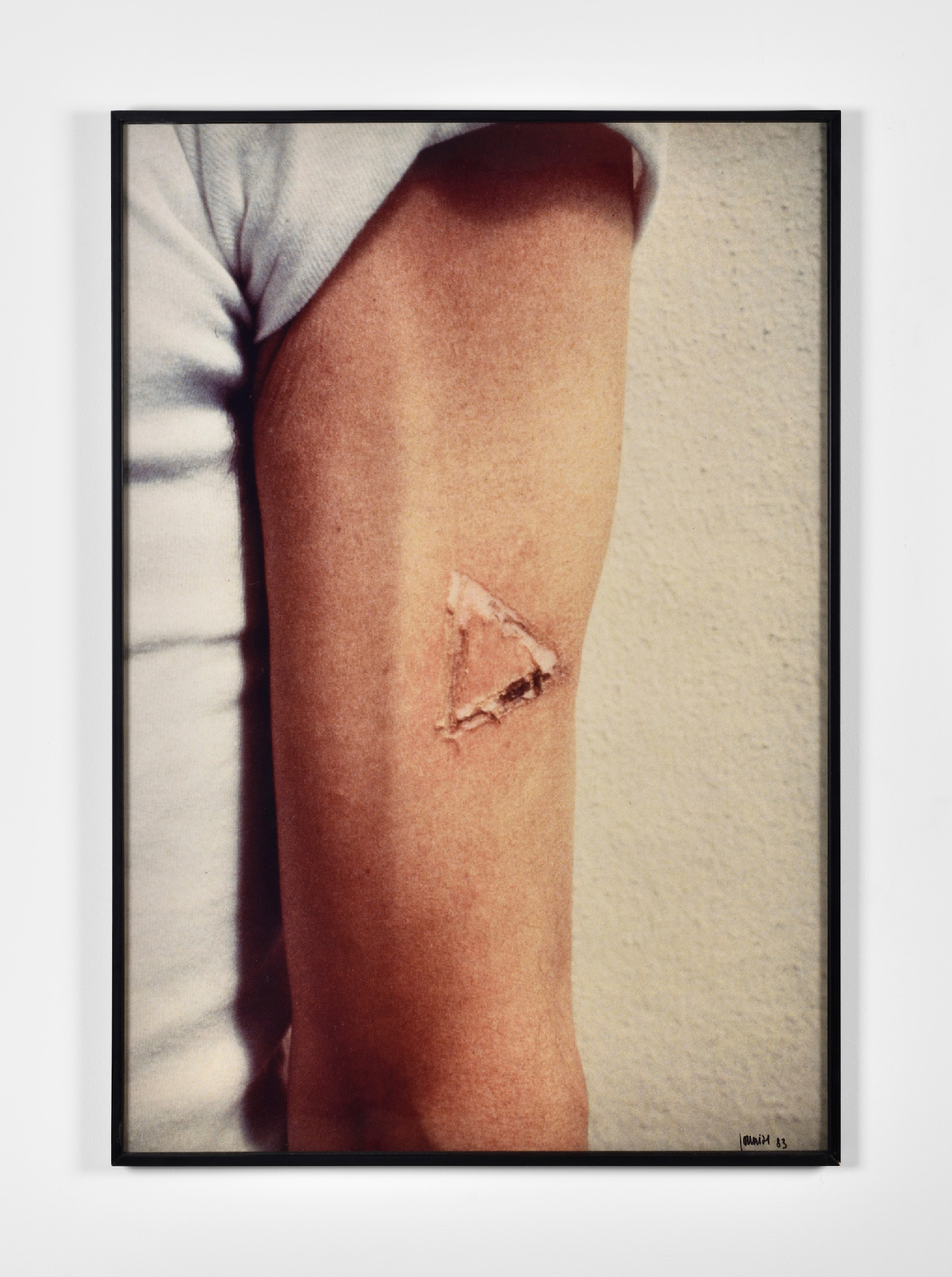
Journiac, who did not succumb to AIDS, nonetheless allegedly claimed the disease as his own embodiment, declaring, “le SIDA c’est moi” (I am AIDS) 3. This declaration served as a visceral response to the epidemic’s crushing toll. His death, tragically, occurred just before he could inaugurate a pioneering exhibition dedicated to the crisis, “Les créateurs face au Sida”, at the Chapelle de la Salpêtrière (see Idier, 2019). The artist’s engagement with the topic began early, in the 1980s, within his Marquages series. This includes the work Marquage d’un corps – Action de corps exclu, 1983-1993 [fig. 5] — an action and portrait that would be central to one of the 12 stages of his culminating series, Rituel de transmutation subtitled “du corps souffrant au corps transfiguré” (1993-1995). Journiac’s Rituel de transmutation constitutes a radical engagement with the trans-subjective conditions of the AIDS crisis. In this period, the experience of being affected by others became tragically inseparable from the fear of infecting or being infected through HIV transmission, highlighting a haunting conjunction of affection and infection. Journiac’s series specifically confronts the social panic over contagion and the resulting repudiation of the HIV-positive person. Articulated across successive stages, Journiac deployed diverse ritualistic actions and aesthetic forms that directly challenged the socially enforced taboo on touching — an action centrally articulated in the photograph of his branded arm — as well as the widespread stigmatization of the infected body. Critically, Journiac returned to his consistent artistic interrogation of blood in his body art — recalling, for instance, Messe pour un corps (1969) — to intervene in and subvert religious doctrines from the late 1960s onward. By problematizing the Catholic miracle of transubstantiation — the presumed transformation of one substance into another based on distinct ontological categories — Journiac displaced the metaphorical power of the ritual onto the raw materiality of the body. This shift effected a de-metaphorization of these physical substances (blood or ashes from deceased friends), where the material is no longer a representation of a sacred body, but the literal, affective trace of a human one. This re-focused attention on the immanent presence, circulation, and somatic inscription of these substances into artworks. This action effectively served to mourn friends lost to a disease caused by the contamination of a virus through blood transmission. This strategic re-engagement with ritualistic actions secured the political possibility of collective grief and solidarity. Evolving thus from his earlier performance practices, Rituel de transmutation functioned as an ethical act of compassionate hospitality and of wit(h)nessing the individual and collective traces of traumatic experiences associated with the AIDS epidemic. On a political level, Journiac directly contested the alienating conditions of a capitalist society whose economic system is predicated on the creation of “bare life” (Agamben, 1998). This is evidenced by Journiac’s denunciation, for instance, of systemic failures, such as the 1992 “Sang Contaminé” scandal involving the circulation of HIV-positive blood to hemophilic patients, which exposed the political and economic elite’s prioritization of financial gain over human life (Sausset and Labaume, 2017). Against this landscape of ostracization, Journiac foregrounded a defiant, transformative communalism. In Marquage au présent (1993) [fig. 6], we are confronted with a close-up of Journiac’s branded arm in black and white. The omission of his face serves to generalize the subject — Journiac or anyone else — while drawing attention to the triangle on his arm. The triangle evokes the Nazi concentration camp method for marking homosexuals, which Journiac uses to denounce the social stigmatization and abjection of HIV-positive homosexuals during the AIDS epidemic. By choosing branding — a permanent cauterization of the skin — rather than a mere representational image, Journiac transforms this historical mark of exclusion into a literal, somatic wound. Although the photograph is black and white, Journiac’s wound refers to the pink triangle, which became a symbol of political contestation and collective solidarity in response to both homophobic political rhetoric and the French government’s and pharmaceutical industry’s lack of support. This political activism, particularly as championed by figures like Journiac, arguably redefined the social function of art itself, a view Journiac consistently asserted in his contributions to arTitudes. Established by François Pluchart in 1971, the influential art journal that championed “body art” in France functioned as a crucial venue for collective creative experimentation.
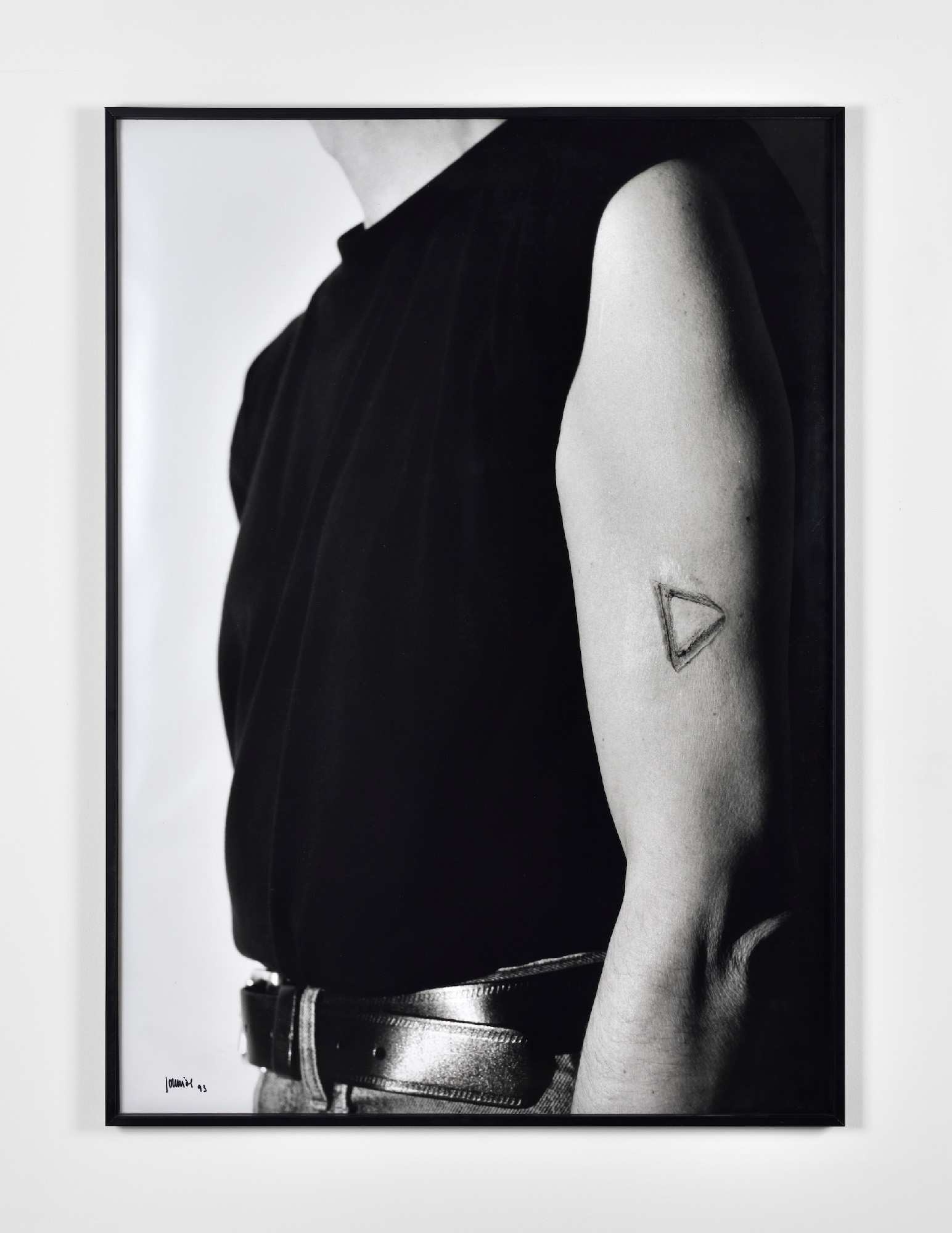
Like the punctum — which Roland Barthes describes as an explosive, poignant, wounding photographic detail compelling affective, visceral, or physical spectator engagement (1984) — the branded triangle on Journiac’s arm unleashes a powerful intellectual, emotional, and affective response. Yet, such a response cannot be contained within the spectator’s subjective experience, as Barthes’s emphasis on the punctum as the wounding contingency that exceeds the studium undercuts the dichotomy between objectivity and subjectivity (Levy, 2009). Journiac’s attention to the scar with blistered skin, to the torn flesh, highlights how the visual wound irrupts through the spectacle of the visible, underscoring the contingent encounter with the obtuse meaning that Barthes identifies as the punctum, which precedes and exceeds intellectual engagement with, and complicates the meaning of, Journiac’s photograph. Georges Didi-Huberman explains:
Through the physical struggle of imitation and incarnation, something passes … that is never theorized, that is never made completely clear; something which would tell us how the visual is torn away from the visible. The visible is the world of idolatry, a world where the image is exhibited, where it becomes representations, despicable performances, satisfied concupiscences. The visual, on the contrary, is what can be seen beyond, in the beyond. The visual characterizes a world where the image is at once present and promised -in short, where it is an aura, the material of the soul. (Cited in Cheval, 2022, p. 34)
By defining the “visual” as this material “beyond” that is torn from the representational “visible,” Journiac explicitly transgresses the socially enforced taboo on touching the infected body. Drawing on Merleau-Ponty’s phenomenology, Didi-Huberman distinguishes between the observable “objective-body” and the “lived-body,” the medium for tact, feeling, and movement. Journiac pushes this conceptual limit by reflecting on embodying an image that integrates animate, spiritual, and material flesh (see Cheval, 2022, p. 34). By engaging with how flesh acquires voice, Journiac prompts reflection on the materiality of touch and its visual re-inscription, maintaining that the tangible and the visible are fundamentally non-dissociable. Because the visible promises the tangible, this process underscores the co-constitutive relationship between visuality and hapticality. This convergence of sight and touch makes their distinction impossible, thereby grounding the thinking of flesh in the tactility-vision nexus. Indeed, as Cavanagh accurately notes, “[t]his limit is, in Ettingerian terms, where a matrixial trace connection may be apprehended” (2022, p. 492).
Drawing on Ettinger’s matrixial psychoanalysis allows us to conceive Journiac’s artwork as a trans-subjective encounter between the spectator and the traces of individual and collective trauma that moves us beyond our individual and finite limits of ego, identity, and body. Emphasizing the transformative aesthetic, ethical, and political potential of this kind of trans-subjective mourning, Ettinger’s term “wit(h)ness” — bearing witness to and with the other — enables us to reflect on how Journiac used his artistic practice to engage audiences in a trans-subjective processing of the traumas associated with the loss, illness, and mortality exposed by the AIDS virus, while simultaneously gesturing towards an aesthetic, ethical, and political transformation in relationality. This emphasis on finitude, mourning, and trans-subjectivity in the context of AIDS, as explored by Journiac, challenges the anti-relational and anti-community focus in some strands of queer theory, such as the work of Lee Edelman (2004). Edelman’s concept of “no-future” distances itself from the pragmatic political concerns of gay movements prioritizing assimilation and the common association of the future with “an always about-to-be-realized identity” (2004, p. 13). Edelman’s engagement with Freud’s death-drive challenges cultural associations of the future with heteronormative notions of kinship based on biological reproduction. However, Edelman’s emphasis on the death-drive also disallows the possibility for associating queerness with not only reproductive but productive ethical and political transformations in an incalculable future yet to come. By contrast, José Muñoz’s 2009 work establishes a connection between queerness and the hope for a “concrete utopia,” a notion of utopia that relates to historically specific struggles. Muñoz argues: “queerness is primarily about futurity and hope. That is to say that queerness is always in the horizon. I contend that if queerness is to have any value whatsoever, it must be viewed as being visible only in the horizon” (2009, p. 11). In other words, queerness is more than destructive of oppressive pasts but productive of yet to be discovered futures. Ettinger’s contribution to these debates emphasizes an ethical relation between the self and the other that is predicated on our common yet singular finitude as the condition of possibility for thinking about the future of queerness without disavowing one’s and the other’s ontological condition of finitude. Journiac’s work thus enables us to reflect on queer relations and community that embrace the mourning of one’s mortality and that of the other without perpetuating the negativity of the death-drive or what Edelman terms a heteronormative notion of “reproductive futurism” (2004, p. 2). Such queer relations and community in Journiac’s art underscore the queer potential for ethical and political transformations in an unpredictable future.
Journiac’s artistic practice can be interpreted as the artist’s spatialization and temporalization, through different aesthetic strategies, of traumatic experiences associated with illness, loss, and death caused by the AIDS epidemic. Journiac’s works affect us, to use Ettinger’s concept, at a “trans-subjective” level beyond the individual subject. If the transmission of HIV across bodies epitomized the trans-subjective conditions of intersubjective sexual relations and subjugation to contagion, the alternative forms of caring for the other that emerged in the context of the AIDS epidemic, as seen in Journiac’s Rituel de transmutation, were the external manifestation of one’s trans-subjective capacity for connecting to the other. In light of the dominant association of HIV-queer people with “ungrievable” subjects, to use Judith Butler’s phrase (2012), and the lack of infrastructural support during the 1980s and early 1990s, the alternative forms of caring for the other practiced by queer subjects were associated with an ethical and potentially political gesture that involved the fragilization of one’s individual psychic and bodily boundaries. This fragilization also served as a condition of possibility for creating a queer social, psychic, and affective space in which the other could become, even if the other was not able to go on living, even if the other was already dead. The ethical implications underpinning the queer forms of caring explored in Journiac’s work were based on the individual’s trans-subjective capacity for self-fragilization as the condition of possibility for accessing the vulnerability in the other, thus leading us to become more aware of our co-human subjectivity and of the need to address the human or non-human with care.
This focus on trans-subjective wit(h)nessing establishes past, current, and future forms of queer social relations that partake of the sharing of traumatic experiences at a trans-generational level. As Joshua Chambers-Letson argues, “it is by a kind of compensatory growing (which occurs through the sharing out of the experience of the incommunicable with the collective) that we carry our losses within us in order to survive them and build a brighter future” (2014, p. 14). In this light, Journiac’s artistic practice is seen as after-images that move us to compassionately embrace traces of traumas and fragments of memory, both subjective and collective, left in the wake of the AIDS epidemic. In other words, the concept of “wit(h)nessing” allows us to bear witness to and with the other, acknowledging that trauma has occurred, but a future is possible. Wit(h)nessing AIDS through Journiac’s œuvre rethinks the artistic medium as a borderspace, a threshold where it may be possible to compassionately encounter individual and collective traumatic experiences, providing the occasion for a transformation of the remnants of trauma into something new. Wit(h)nessing Journiac’s work allows a queer community to share the residues of personal and collective histories of suffering, defiance, and desire caused by the AIDS epidemic and to look forward to an unpredictable future in which hope is still possible. AIDS remains a fatal illness in countries beyond the Global North, and HIV-positive people still face significant discrimination and bigotry. Hence, Journiac’ artistic practice remains vital for drawing audiences into the artistic medium, thus helping us better understand, as Journiac had recognized in his constant emphasis on “l’art sociologique”, its role in creating a more inclusive, welcoming, and equitable world4.
References
Agamben, G. (1998). Homo Sacer: Sovereign Power and Bare Life. Stanford University Press.
Agamben, G. (2000). Means Without End: Notes on Politics. University of Minnesota Press.
Barthes, R. (1984). Camera Lucida: Reflections on Photography. Hill and Wang.
Bennett, J. (2007). Aesthetics of Intermediality. Art History, 30.3, 432–50.
Bersani, L. (1987). Is the Rectum a Grave? October, 43, 197–222.
Butler, J. (2012). Precarious Life, Vulnerability, and the Ethics of Cohabitation. The Journal of Speculative Philosophy, 26. 2, 134–51.
Cavanagh, S. (2022). Transgender and the Other Sexual Difference in Vivek Shraya’s Trisha. Psychoanalysis, Culture and Society, 27.4, 485-501.
Chambers-Letson, J. (2014). Compensatory Hypertrophy, or All about My Mother. Social Text, 32.1, 13–24.
Cheval, O. (2022). The Injury: On Pathosformel in João Pedro Rodrigues’s Work. Refocus: The Films of João Pedro Rodrigues and João Rui Guerra da Mata. Ed. Duarte, J. and Rosário, F. Edinburgh University Press, 28-40
Debevec Henning, S. (1982). The Ritual Im-plications of Genet’s Les Bonnes. boundary 2, 10.2, 219–43.
Deleuze, G., & Guattari, F. (1972). Capitalisme et schizophrénie 1: L’Anti-Œdipe. Les Éditions de Minuit.
Derrida, J. (1972). Freud and the Scene of Writing. Yale French Studies, 48, 74–117.
Dickinson, C. (2011). Beyond Violence, Beyond the Text: The Role of Gesture in Walter Benjamin and Giorgio Agamben, and its Affinity with the Work of René Girard’, Heythrop Journal, L11, 952–61.
Docquiert, D. (2017). Michel Journiac, L’action photographique. Xavier Barral.
Edelman, L. (2004). No future: Queer theory and the Death Drive. Duke University Press.
Ettinger, B. L. (1992). Matrix and Metramorphosis. Differences, 4.3, 176–208.
Ettinger, B. L. (2005). Co-poiesis. Framework X Ephemera, 5.10, 703–13.
Freud, S. (1962 [1923]). The Ego and the Id. Norton.
Gutiérrez Albilla, J. (2024). Finitud, duelo y trans-subjetividad en Almodóvar: releyendo la epidemia del SIDA en Todo sobre mi madre (1999). Estudios LGTBTIQ+: Comunicación y Cultura, 4.1, 15-21.
Hequembourg, A. (2007). Becoming Lesbian Mothers. Journal of Homosexuality, 53.3, 153–80.
Hocquenghem, G. (1972). Le désir homosexuel. Éditions Universitaires.
Idier, A. (2019). Pureté et impureté de l’art. Michel Journiac et le sida. Sombres torrents.
Kristeva, J. (1991). Strangers to Ourselves. Columbia University Press, 1991.
Lacan, J. (2007). The Seminar of Jacques Lacan: The Other Side of Psychoanalysis (Book XVII) (R. Grigg, Trans.). W. W. Norton & Company.
Levy, L. (2009). The Question of Photographic Meaning in Roland Barthes’ Camera Lucida. Philosophy Today, 53. 4, 395-406.
Muñoz, J. (2009). Cruising Utopia: The Then and There of Queer Futurity. New York University Press.
Sartre, J.-P. (1954). Introduction. The Maids and Deathwatch: Two Plays by Jean Genet. Grove Press, 7–31.
Sausset, D., and Labaume, V. (2017). Michel Journiac, Rituel de Transmutation et Contamination au présent, journal de l’exposition. Le Transpalette, Centre d’Art Contemporain.
Ten Bos, R. (2005). On the Possibility of Formless Life: Agamben’s Politics of the Gesture. Ephemera, 5. 1, 26–44.
Watney, S. (1997). Policing Desire: Pornography, AIDS and the Media. University of Minnesota Press.
Weber, S. (2006). Going along for the Ride: Violence and Gesture: Agamben Reading Benjamin Reading Kafka Reading Cervantes. The Germanic Review, 81.1, 65–83.
Wilson, S. (2003). Michel Journiac’s Masquerades, Incest, Drag and the Anti-Oedipus. Männlichkeit als Maskerade: Gender Studien mit Blick auf ‘den’ Mann. Ed. Benthien, C. and Stephan, I. Böhlau Verlag, 128–153.
- In this article, the term “queer” functions as a theoretical lens rather than an anachronistic identity marker. Journiac’s artistic practice, rooted in the ritualized disruption of gender essentialism and the deconstruction of the social body, is inherently aligned with a queer methodology. By applying this framework, I aim to illuminate how Journiac’s work prefigures contemporary discourses, treating his artistic interventions as a site of resistance that disrupts the categorical boundaries of his historical moment. [Retour au texte]
- I wish to acknowledge a profound intellectual debt to Sarah Wilson. Her pioneering work (2003) on the relationship between critical theory and French visual culture has been a constant source of inspiration for my work. [Retour au texte]
- My deepest thanks to Armance Léger for sharing this crucial biographical detail with me in an informal conversation in Marseille in 2023. [Retour au texte]
- I have engaged with these questions in Gutiérrez Albilla (2024). [Retour au texte]